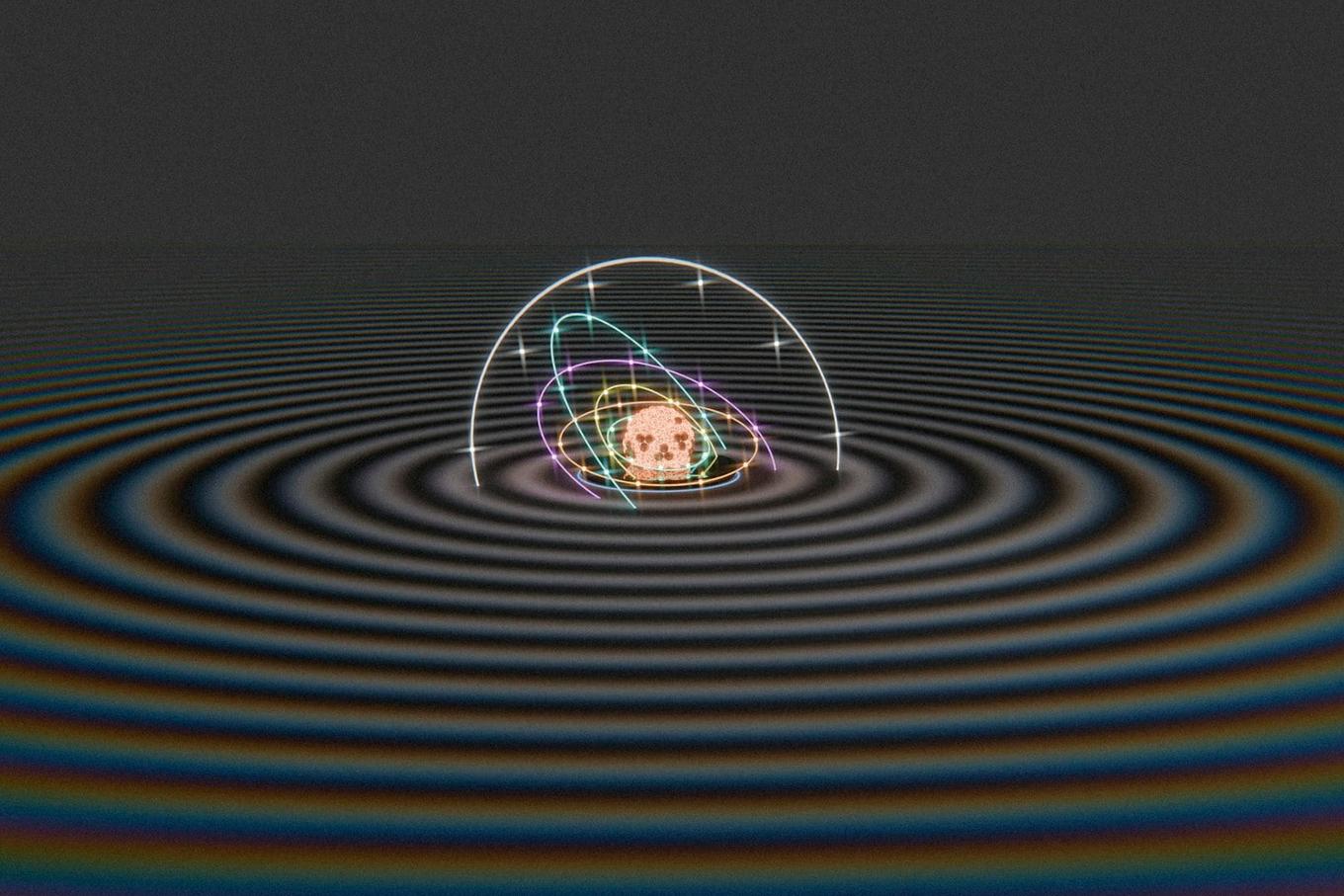
Gravitational waves, the ripples in spacetime first detected directly in 2015, are normally thought of the way we think of waves on the sea or sound in the air: disturbances that travel outward and eventually dissipate. A new theoretical study, reported by Phys.org, proposes something stranger: gravitational waves that stay put.
The research, published in the journal Physica Scripta by physicist Rodrigo Berté, borrows a concept from an entirely different field: photonics, the study of light and optical systems. In recent years, engineers working with light have learned to design materials that trap certain wavelengths in place rather than letting them radiate away. These are known as ‘bound states in the continuum’, or BICs.
Borrowing a trick from light to trap gravity
A bound state in the continuum is a genuine physics puzzle. Ordinarily, if a wave’s frequency falls within a continuous range where free-travelling waves exist, that wave should eventually leak away and radiate outward. BICs defy this by remaining perfectly localised, protected by symmetry, even though the surrounding conditions would normally let them escape. Photonics researchers have spent roughly the past decade demonstrating BICs in engineered dielectric structures, unlocking applications in lasers, sensors and optical filters.
According to Phys.org’s account of the study, Berté proposes a gravitational-wave equivalent: periodic, exponentially localised distortions of spacetime that sit inside the continuum of possible gravitational wavevectors without radiating away, much as their photonic cousins do. In the language of general relativity, these would be described as symmetry-protected metric perturbations confined to idealised, highly simplified geometric setups such as flat planes.
“When one mentions ‘waves,’ we immediately think of a perturbation that propagates... The same idea of propagating perturbations applies to gravitational waves (GWs).”
Why physicists care about gravity and light swapping places
The motivation is not purely mathematical curiosity. Physicists already know that under extreme conditions, such as very strong magnetic fields, gravitational waves and photons can convert into one another, a phenomenon tied to what is known as the Gertsenshtein effect. This conversion is one of the few theoretical bridges between gravity and quantum physics, since photons are well understood as quantum particles while gravitons, the hypothetical quantum particles of gravity, remain unconfirmed.
The trouble, as the study notes, is that gravitational waves and electromagnetic waves tend to fall out of step with each other under these extreme conditions, limiting how cleanly they can be studied together. Photonics researchers have learned to manage similar mismatches using quasi-BICs, near-perfect versions of the fully trapped state that still leak very slowly. The new paper suggests gravitational wave versions of these quasi-BICs might offer a similarly useful tool, potentially helping researchers study how gravity might contribute to quantum effects such as entanglement and decoherence, the loss of quantum behaviour in a system.
A theoretical idea, and a European detection effort still years away
It is worth being clear about the limits of the work. As with much foundational physics, the proposal rests on idealised, simplified models of spacetime rather than conditions found in real astrophysical environments, and the paper itself frames the concept as a first step rather than a practical detection scheme.
The timing is notable for European readers, given the continent’s growing investment in gravitational wave science. The Virgo detector near Pisa, Italy, already works alongside the American LIGO observatories to detect conventional gravitational waves from events such as merging black holes. Looking further ahead, European scientists are developing the Einstein Telescope, a next-generation underground detector with candidate sites in Sardinia and the Euregio Meuse-Rhine border region spanning Belgium, Germany and the Netherlands, alongside the European Space Agency’s planned LISA mission, a space-based observatory designed to detect gravitational waves at frequencies inaccessible from the ground. None of these projects currently target the ultra-high-frequency regime where gravitational-wave BICs would theoretically appear, underscoring how far this idea sits from observational testing.
For now, the concept remains a theoretical proposal exploring what gravitational waves could do under highly specific, simplified conditions. Its real value, the researchers suggest, may lie less in immediate application and more in offering physicists a new conceptual tool for probing the relationship between gravity, quantum mechanics and the structure of spacetime itself.
This article is free to read. It always will be — no paywall, no account, no tracking.