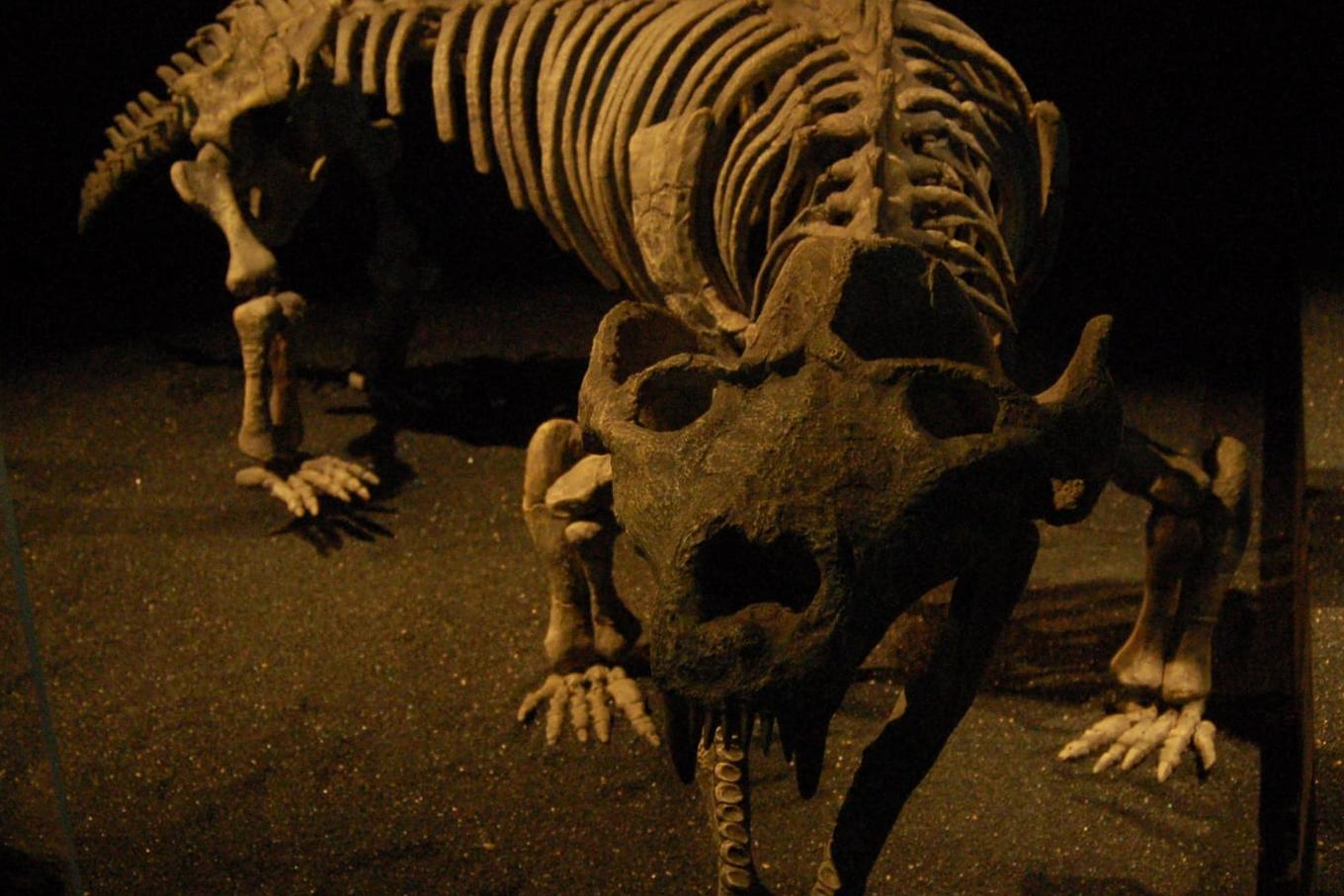
A fossil unearthed in South America is reshaping assumptions about how early relatives of mammals reproduced. Researchers studying the skeleton of Chiniquodon theotonicus, a cynodont that lived roughly 236 million years ago, say they have found the first strong anatomical evidence that this ancient lineage gave birth to live young rather than laying eggs.
Cynodonts were a group of mammal-like reptiles from the Triassic period that eventually gave rise to all modern mammals. Until now, most scientists assumed these distant ancestors reproduced the way reptiles typically do today, by laying eggs. The new study, published in the journal Frontiers in Mammal Science, challenges that picture.
What the fossil shows
The research team, led by Dr Leandro Gaetano, a paleontologist at Argentina’s National Scientific and Technical Research Council (CONICET), examined embryonic tissue preserved in the fossil, including what is known as a neonatal line, a growth marker in bone that forms around the time of birth. Such tissue had never previously been documented in a cynodont.
“We show for the first time that live birth was present in at least one mammalian ancestor, Chiniquodon theotonicus, which lived approximately 236 million years ago,” said Gaetano.
According to the study, as reported by phys.org, the finding implies that viviparity, the scientific term for giving birth to live young, appeared in the mammalian lineage roughly 90 to 95 million years earlier than researchers had previously thought. Co-author María Miceli Baro, a graduate student at the University of Buenos Aires, noted that embryonic tissue of this kind had simply never been observed before in cynodonts, and that a trait linked to evolutionary success in mammals was already present long before true mammals existed.
A more complicated picture of ancient reproduction
The discovery arrives only months after a separate study, also covered by phys.org, reported fossil evidence that another mammal ancestor, Lystrosaurus, laid eggs around 250 million years ago. Taken together, the two findings suggest that reproductive strategies among the various lineages leading to mammals were more varied than a single, tidy evolutionary story would suggest. Today, the vast majority of mammals give birth to live young, but monotremes such as the platypus and echidna still lay eggs, a reminder that both strategies persisted long after mammals themselves emerged, as science outlet Gizmodo has noted.
Senior author Adriana Mancuso, also of CONICET, placed the finding in its broader environmental context. Cynodonts lived through the Triassic period, a time when ecosystems were still recovering from the Permian-Triassic extinction, one of the most severe mass extinctions in Earth’s history. Understanding how reproductive strategies evolved during that recovery period could help explain why some lineages thrived while others died out.
“It is very well possible that C. theotonicus does not represent an isolated case of viviparity among cynodonts. It could be evidence of the general switch from laying eggs to giving birth to live young early on in the mammalian lineage. But we need more evidence to test this hypothesis,” Gaetano said.
The researchers are careful to stress that their conclusions rest on a single fossil specimen, a limitation common to much of paleontology given how rarely soft tissue and embryonic material survive over hundreds of millions of years. The team says it now plans to search for similar embryonic evidence in other cynodont fossils held in museum collections, using modern imaging techniques to see whether the pattern holds up across the wider group. If it does, it would mark a significant revision to the timeline of one of the most fundamental traits shared by humans and nearly all other mammals alive today.
This article is free to read. It always will be — no paywall, no account, no tracking.