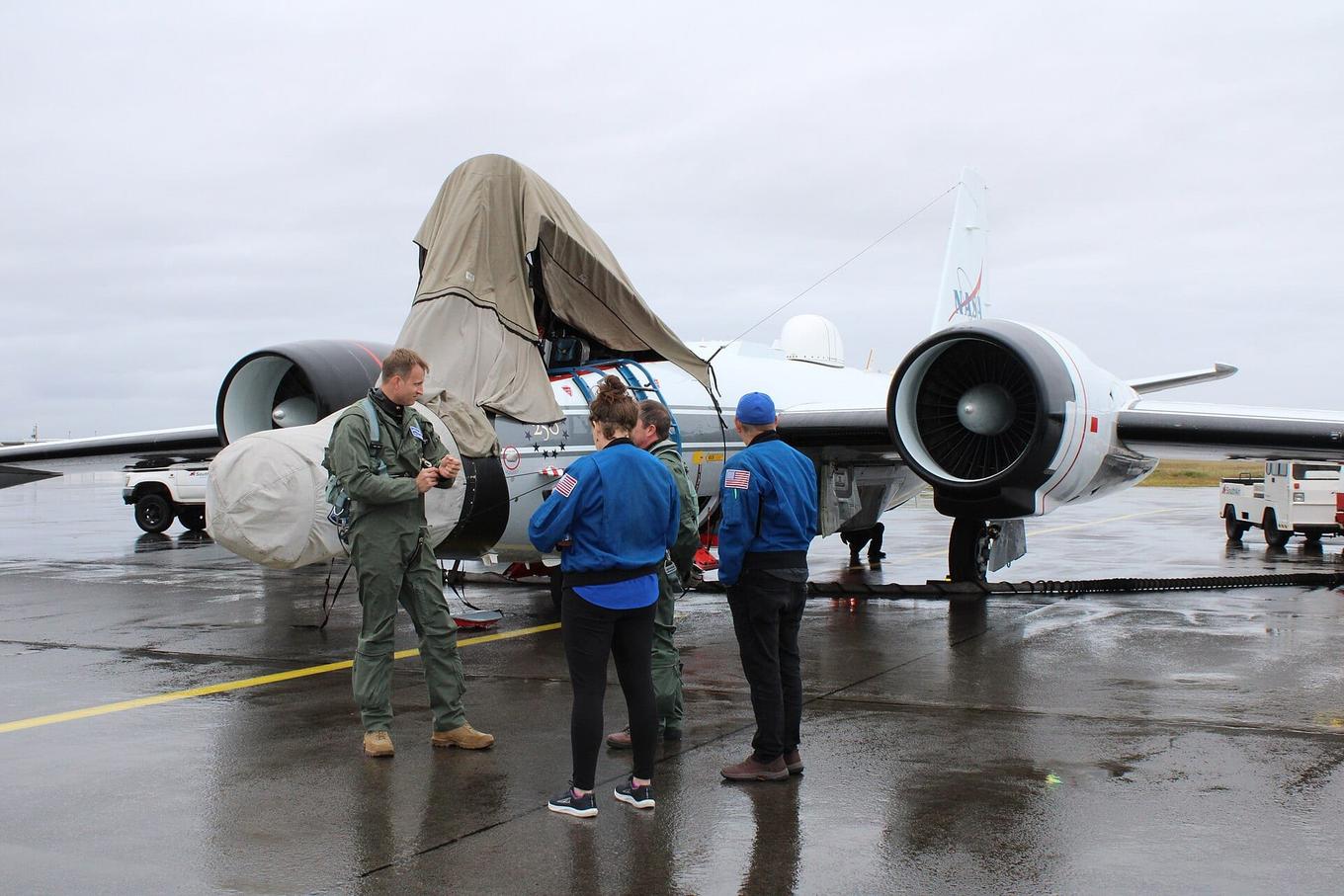
A total solar eclipse swept across the North Atlantic on Wednesday, August 12, and for observers on the ground in Iceland the view was largely obscured by cloud. High above the weather, however, a NASA research jet got a clear look.
Using specialised equipment fitted to NASA’s WB-57 aircraft, a team led by the Southwest Research Institute (SwRI) in Boulder, Colorado, successfully observed the eclipse from 50,000 feet, about 15,000 metres, off Iceland’s coast, according to phys.org. The high-altitude jet followed the moon’s shadow to take measurements of the sun’s corona, the faint outer atmosphere of the sun visible only during totality, in nine different wavelengths spanning visible and infrared light.
Chasing the shadow at nearly the speed of sound’s fraction
The WB-57 is a modified Cold War-era Canberra bomber that NASA has repurposed as a high-altitude research platform. In its nose cone it carried the SCIFLI Multispectral Airborne Imager, known as SAMI, a suite of cameras built by NASA’s Langley Research Center that records the corona at a minimum of 20 frames per second.
Flying at around 460 miles per hour, roughly 740 kilometres per hour, in the same direction as the moon’s shadow, the aircraft could keep the sun eclipsed for far longer than any fixed observer on the ground. Reporting on the mission ahead of the flight, Forbes noted that the aircraft’s speed allows scientists to follow the moon’s shadow, extending observation time from just over two minutes on the ground to nearly three minutes in the air. That extra time, under a minute, yields hundreds of additional high-resolution frames of the corona for researchers to analyse.
“This eclipse was the perfect opportunity to use the unique imaging capabilities of NASA’s high-flying research observatory,” said Dr. Amir Caspi, a senior program manager at SwRI’s Solar System Science and Exploration Division.
Caspi, the mission’s principal investigator, said the project was carried out with NASA’s Johnson Space Center in Houston and Langley Research Center in Virginia. He noted that the eclipse track ran mostly over the Atlantic Ocean, in locations where clouds are common, which underlined the value of an aircraft that can simply climb above the weather rather than depend on clear skies at a fixed ground site.
An eclipse spanning Greenland, Iceland, Russia, Spain and Portugal
Wednesday’s eclipse path crossed Greenland, Iceland, a stretch of northern Russia, open Atlantic waters, mainland Spain and a small corner of Portugal, making it one of the more geographically striking eclipses to touch Europe in recent years. A partial eclipse was visible across much of the rest of Europe, according to coverage of the event.
The WB-57 was not the only airborne experiment tracking the shadow. An Irish Air Corps aircraft carried scientists from the European Space Agency and the Dublin Institute for Advanced Studies, who imaged the corona using a coronagraph, an instrument that blocks the sun’s bright disc to reveal its faint atmosphere, built from spare components originally intended for ESA’s Proba-3 and Solar Orbiter missions. Separately, student teams in Iceland and Spain launched dozens of research balloons to measure how the atmosphere responds when daylight briefly disappears.
Caspi said the SwRI team had learned from a previous WB-57 eclipse flight in April 2024 over North America, when some images were affected by vibration, and had adjusted the instrument’s exposure settings accordingly ahead of this year’s mission.
“We achieved all of our mission objectives,” Caspi said. “This spectacular success was made possible by the efforts of the entire team, including the WB-57 air and ground crew who executed the mission, the SCIFLI/SAMI team who built and calibrated the instrument, the science team who planned and will analyze the observations, and even the U.S. Navy and government of Iceland, who hosted us and provided extensive logistical support.”
Scientists hope the data gathered will improve understanding of solar prominences, the corona’s puzzlingly high temperatures of over a million degrees, and how solar material escapes the sun to form the solar wind, the constant stream of charged particles that can affect satellites, power grids and communications on Earth. Full analysis of the images is expected to take some time, but researchers say the mission has already delivered the clean, cloud-free observations they set out to capture.
This article is free to read. It always will be — no paywall, no account, no tracking.