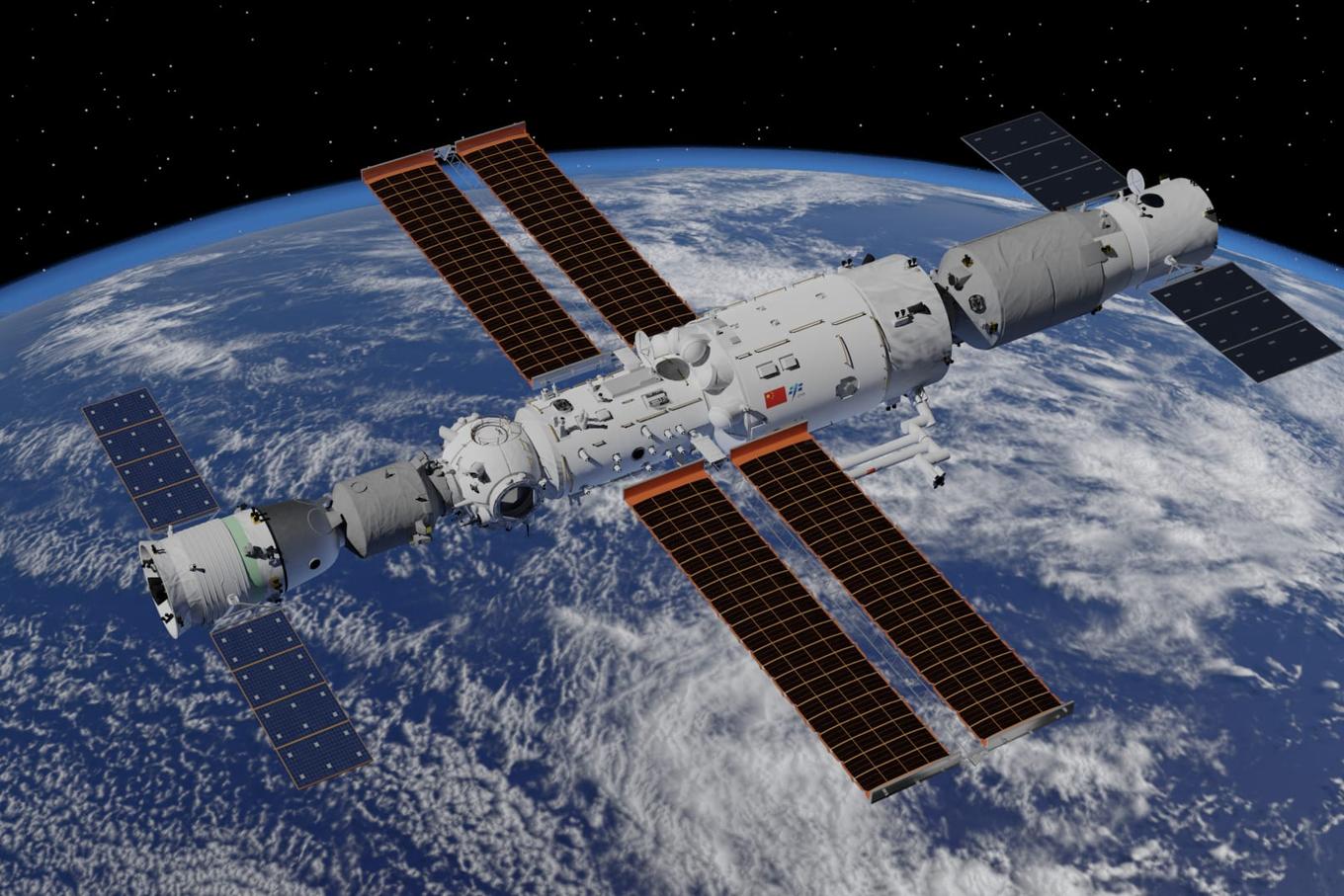
Physicists working aboard China’s Tiangong space station have produced the coldest temperature ever measured for a gas of atoms, cooling a cloud of rubidium to an equivalent temperature of 9.7 picokelvins, or 0.0000000000097 kelvin above absolute zero. The result, published in the journal Science, surpasses every previous attempt on Earth or in orbit.
The study’s authors, led by Wei Xiong, Tang Li and Shengjie Jin, worked with teams from Peking University, the Shanghai Institute of Optics and Fine Mechanics, and the Chinese Academy of Sciences’ Technology and Engineering Center for Space Utilization. In their paper, they describe the result as, in their words, ‘the lowest equivalent temperature ever measured,’ according to ScienceAlert.
Beating Bremen and the ISS
The new figure replaces a 2021 record of 38 picokelvins, set during a brief free-fall experiment at Germany’s Bremen Drop Tower, a German-French collaboration at the University of Bremen. It also outperforms NASA’s Cold Atom Laboratory aboard the International Space Station, which reached 52 picokelvins using magnetic trapping and a technique called matter-wave lensing, according to phys.org.
The Tiangong experiment relied on the Cold Atom Physics Rack, a device installed in the station’s Mengtian laboratory module in 2022. It uses lasers and nested optical traps to cool and confine a rubidium Bose-Einstein condensate, a state of matter in which atoms behave as a single quantum entity. Researchers calculated the equivalent temperature by measuring how slowly the atom cloud expanded once released from the trap, a standard technique in ultracold physics.
Why seven seconds matters
Microgravity aboard the station let the released cloud stay observable for seven seconds, far longer than is possible in ground-based labs, where gravity pulls atom clouds out of view within fractions of a second. Scientists say this window, not just the raw temperature, is central to the experiment’s value.
The 7 seconds is an even more important figure of merit than the 10 picokelvin — Holger Mueller, atomic physicist, University of California, Berkeley
Mueller, who was not involved in the study, told Science that ground-based experiments may eventually match the temperature achieved on Tiangong. ‘Someday somebody may get something on the ground as cold as 10 picokelvin,’ he said, according to the journal’s news coverage.
For context, the atoms in the experiment were far colder than anything found naturally in the universe. The cosmic microwave background, the faint radiation left over from the Big Bang that fills all of space, sits at roughly 2.7 kelvin, making Tiangong’s atom cloud about 280 billion times colder, according to ZME Science and Space.com.
Researchers say the achievement could sharpen future tests of Einstein’s theory of gravity and improve atom interferometers, instruments used for precision measurement in space, including navigation and gravity sensing.
This article was researched and drafted with AI assistance and reviewed by Lasse Pedersen before publication. How we use AI
This article is free to read. It always will be — no paywall, no account, no tracking.