Physicists at the University of Toronto have confirmed one of quantum mechanics’ oddest predictions: that light can appear to spend a negative amount of time inside a cloud of atoms before emerging on the other side. The result, reported in the journal APL Quantum and first covered by ScienceDaily, builds on a widely discussed 2024 experiment from the same lab.
What the experiment measured
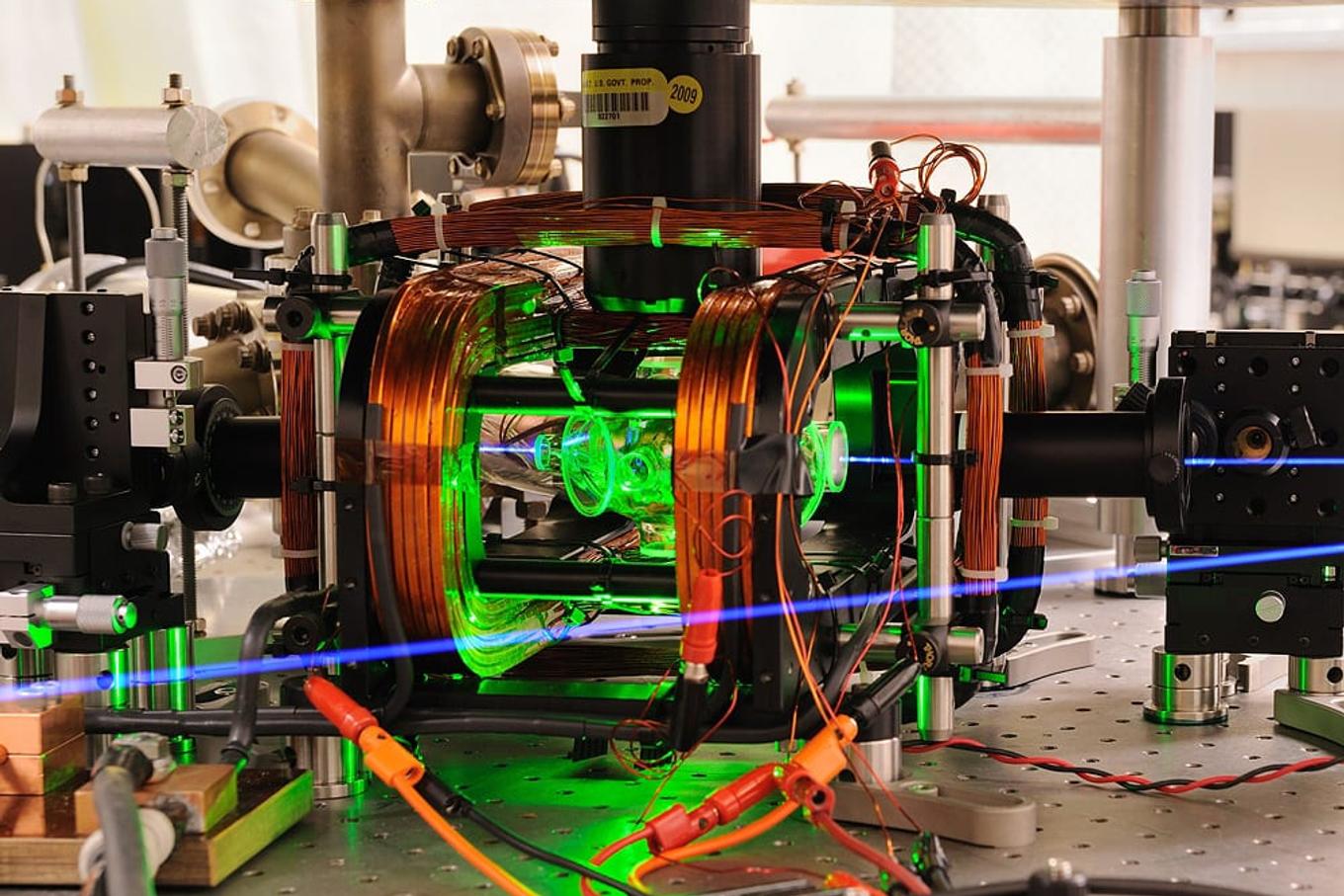
The team, led by experimental physicist Aephraim Steinberg with Daniela Angulo as first author, cooled rubidium atoms close to absolute zero and sent extremely faint pulses of light through the cloud, weak enough that individual photons could be tracked. A second, separate laser beam acted as a kind of monitor, continuously checking whether the atoms were in an excited state as the photons passed through, similar in principle to how a heartbeat monitor tracks a patient without interrupting them.
This built on earlier work in which the team had measured how long atoms stayed excited after interacting with transmitted photons, using a separate off-resonant probe laser to track the atomic cloud’s optical properties. In some runs, the light pulses showed what physicists call negative group delay: the outgoing pulse peaked earlier than it should have if the light had simply travelled at its expected speed through the medium.
That mathematical result has been known since at least the 1990s, but many physicists dismissed it as an artefact of how a pulse’s shape gets reconstructed, not evidence that anything inside the atoms genuinely happened before its time. Steinberg himself, a co-author of a 1993 paper describing negative delays, had long treated the negative values as a mathematical curiosity rather than something with physical weight, as he later told Physics World.
Testing whether it was real
To settle the question, the researchers needed to query the atoms directly, asking how long the photon’s energy had actually dwelled inside them as an excitation, without disturbing the delicate quantum interaction so much that it disappeared. Physicist Eliahu Cohen, writing for The Conversation, explained that a precise measurement at every instant would prevent the atoms from interacting with the photon at all, since measurement in quantum mechanics inevitably disturbs the system being observed.
“We don’t want to say anything traveled backward in time. That’s a misinterpretation,” Steinberg said, according to Phys.org.
The solution was to make so-called weak measurements, gentle enough not to collapse the quantum state, and average the results across roughly one million experimental runs, according to a report by Tom’s Hardware. That painstaking process, spanning about 70 hours of data collection across seven different experimental settings, produced a clear signal: the atoms themselves recorded the same negative duration that the light pulse had implied, confirming the effect was not simply a trick of pulse geometry.
Why it matters, and what it doesn’t mean
The researchers are careful to draw a firm line under any suggestion of time travel. According to the University of Toronto’s Centre for Quantum Information and Quantum Control, the team does not claim that photons travel backward in time, despite how some press coverage framed the result. The photons involved carry no usable information, so the finding does not conflict with Einstein’s special relativity, which forbids information or matter from travelling faster than light.
Instead, the significance lies in showing that quantities long treated as mathematical bookkeeping, so-called weak values, can correspond to something measurable in a real physical system. As Steinberg put it to Physics World, values he and colleagues once dismissed as not physically relevant now appear to carry more physical significance than previously assumed.
For European readers following quantum research, the result adds to a growing body of work, including experiments at institutions across the UK, Germany and France, probing the boundaries between quantum theory’s mathematical formalism and what can actually be observed in the lab. The Toronto findings, developed with theoretical input from Howard Wiseman at Griffith University in Australia, do not overturn any established law of physics. They instead sharpen a decades-old puzzle about how light and matter exchange energy at the smallest scales, turning an equation once quietly ignored into something physicists must now take seriously.
This article is free to read. It always will be — no paywall, no account, no tracking.