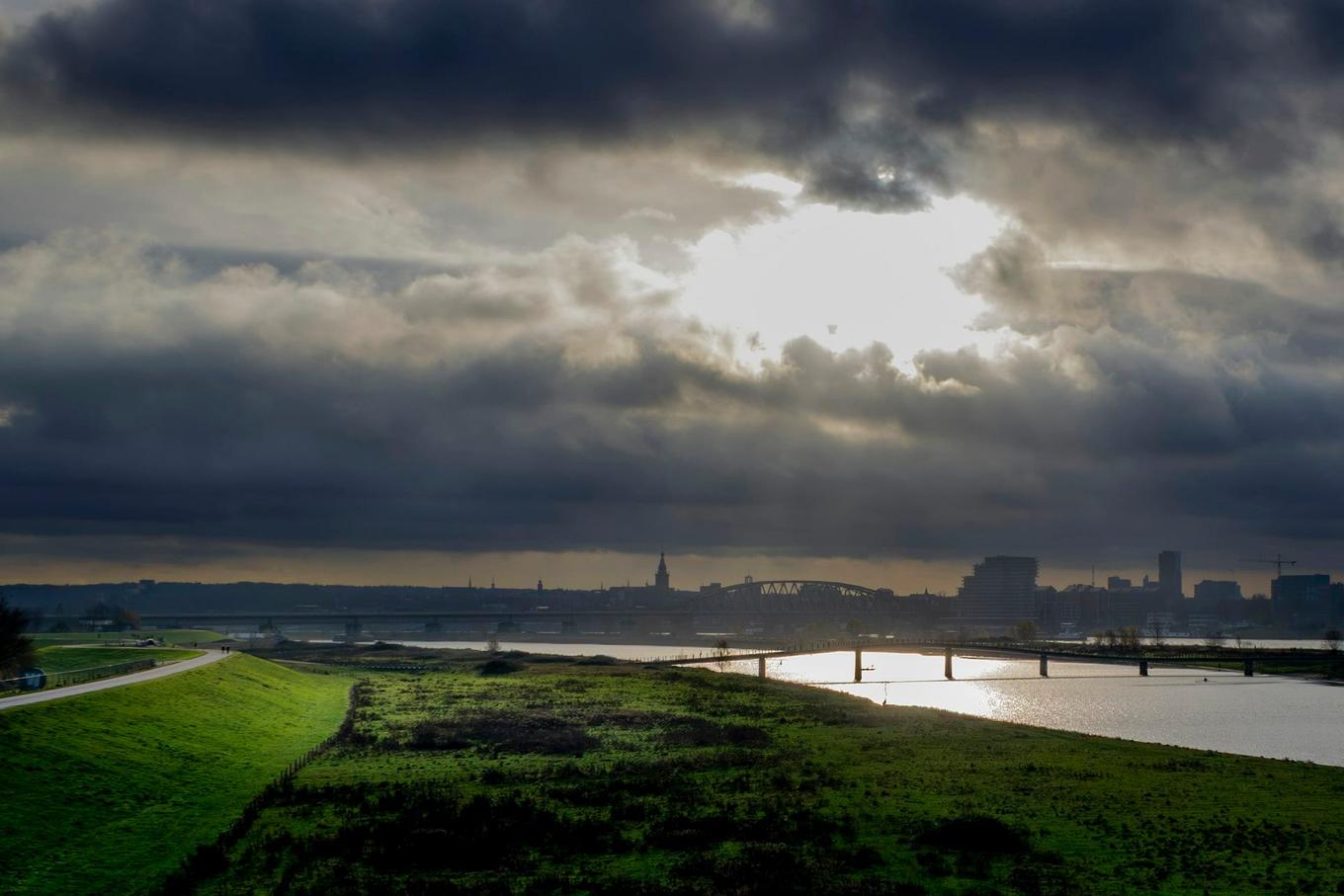
In Nijmegen, a city on the Waal, the main Dutch branch of the Rhine, sandbanks that have not been visible in decades have surfaced this summer. Locals have taken to sunbathing and even lighting campfires on stretches of riverbed that would normally be underwater, while a rusted bicycle and an abandoned shopping cart lie exposed where the current used to run.
The scene reflects a country grappling with its driest conditions in generations. According to the Dutch Ministry of Infrastructure and Water Management’s Drought Monitor, released in early August, the Netherlands is facing what officials describe as an “exceptional situation of prolonged drought.” The Royal Netherlands Meteorological Institute (KNMI) recorded just 13 millimetres of rainfall in July, compared with a long-term average of roughly 78 millimetres for the month.
A river running dry
The Rhine’s discharge at Lobith, the point where the river crosses from Germany into the Netherlands, has fallen to 615 cubic metres per second, the lowest figure ever recorded there, according to Xinhua’s reporting on Dutch government data. The Meuse, which flows through France and Belgium before reaching the Netherlands, is similarly depleted. Forecasters expect the country’s precipitation deficit to exceed 300 millimetres by the end of August, a shortfall that could make 2026 one of the driest years on record.
The consequences are visible well beyond the riverbanks. The Waal remains one of Europe’s busiest inland shipping corridors, carrying around 120,000 vessels a year according to regional tourism authorities, but low water is forcing barges to lighten their loads. Reports from Dutch news outlets describe cargo ships now carrying as little as 70 percent of their usual capacity, while some private boats sit stranded in marinas, their hulls resting on exposed mud.
“I’ve never seen the river this shallow in my life,” a motorcyclist who travelled 70 kilometres to see the low water for himself told Xinhua.
From engineering floods to managing scarcity
The irony is not lost on a country whose entire identity is built around holding back water. Dutch engineering has spent centuries perfecting dikes, dams and pumping stations to keep the sea and swollen rivers out of low-lying polders. Now, officials at the national research institute Deltares say the challenge is shifting toward the opposite problem: making sure there is enough fresh water to go around during increasingly long, dry summers.
One boat owner near Nijmegen, quoted by news agencies covering the drought, said the low-water season used to last about a month but now stretches to roughly three, a change he attributed to the broader effects of climate change. Authorities have already restricted lock operations in several areas to conserve water, and a national water scarcity team has been activated to coordinate how limited supplies are prioritised across drinking water, agriculture and industry, which relies on river water for cooling.
Farmers have been hit particularly hard. Under the Netherlands’ longstanding water distribution rules, known as the ‘displacement series,’ irrigation for crops ranks below drinking water and safety needs when supplies run short, meaning bans on agricultural water use are among the first measures imposed during a shortage. Water quality has also suffered, with blue-green algae blooms and fish deaths reported in several regions, even as officials say drinking water supplies remain secure.
Looking for longer-term fixes
Beyond emergency measures, Dutch policymakers are now discussing structural changes. Under the government’s Delta Programme, a long-running national planning effort, officials have set a goal of making the country’s main water systems climate resilient by 2050 through a strategy for freshwater supply. Deltares researchers point to options including expanded regional water storage, restored wetlands that can act as natural sponges, and changes to farming practices that reduce overall water demand.
For a nation that has long prided itself on controlling water rather than conserving it, the debate marks a notable shift. As one Deltares assessment put it, the 2026 drought shows that water availability is no longer solely a Dutch problem, but one shaped by climate change and rising demand across the entire Rhine and Meuse catchment that stretches through Germany, France, Belgium and the Netherlands. That reality is pushing Dutch water managers toward a more cautious, storage-focused approach, even as they continue to defend the country against the opposite threat: rising seas.
This article is free to read. It always will be — no paywall, no account, no tracking.