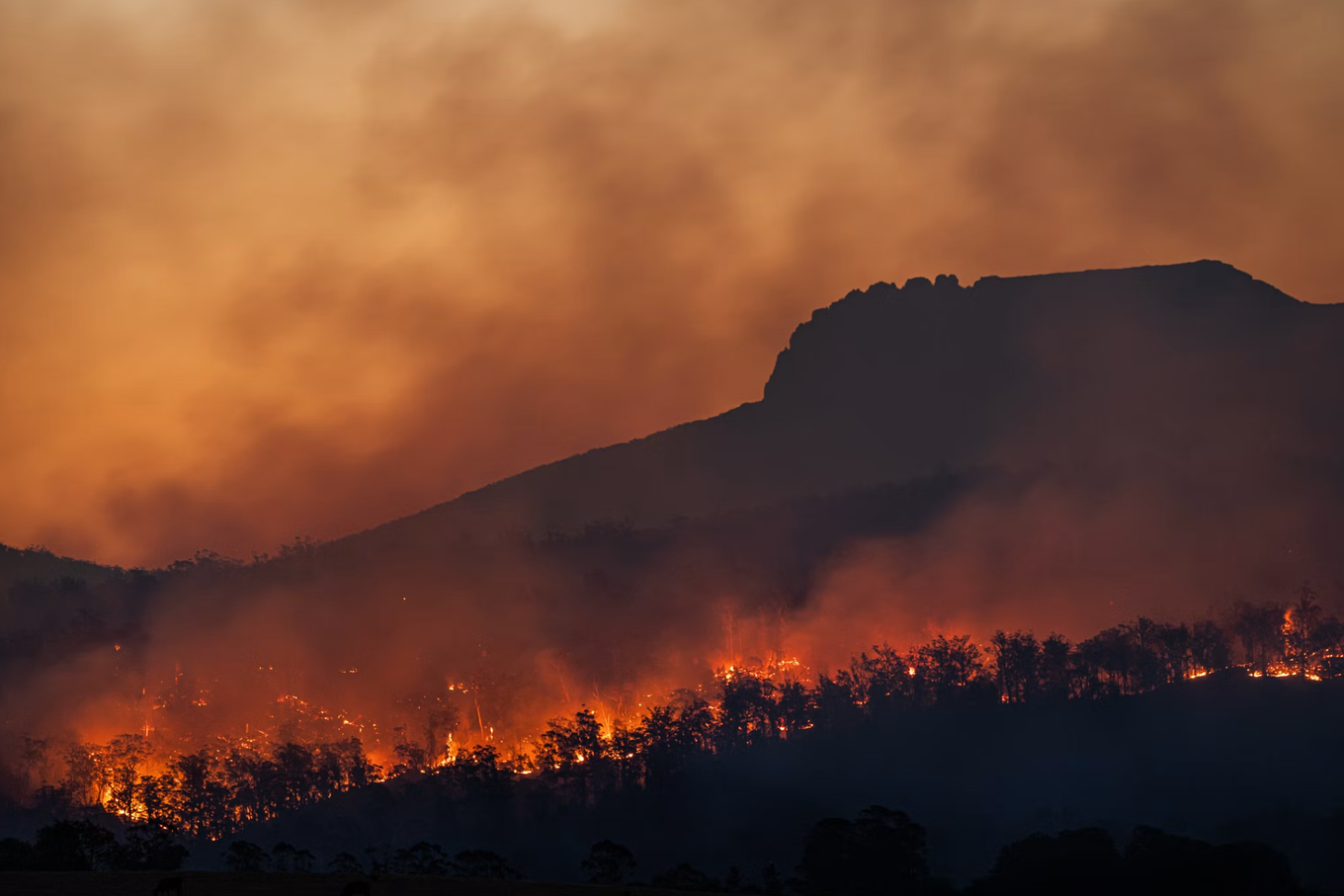
Wildfires are tearing through southern Europe, forcing tens of thousands of people from their homes and stretching emergency services across the continent. The blazes follow a record-shattering June heatwave that, according to the Copernicus Climate Change Service, made last month the hottest June ever recorded in Western Europe, averaging 3.05°C above the 1991–2020 norm.
France, Spain and Greece all burning at once
In France, the most urgent crisis unfolded near Trévillach in the Pyrénées-Orientales, a mountainous region bordering Spain. A fast-moving fire ignited on Saturday and burned through roughly 46 square kilometres of forest and scrubland. France’s Interior Minister Laurent Nuñez confirmed that nearly 12,000 residents had been evacuated and that the fire remained out of control, having already consumed more than 12,000 acres, Inside Climate News reported.
The blaze also forced officials to close a section of the Tour de France to spectators. The race’s third stage, passing through the Pyrénées, went ahead but public access was restricted so that firefighters could move freely along the route. Hundreds of additional evacuations were carried out in Spain and Greece, where emergency crews faced similarly extreme conditions.
In Spain, the season’s deadliest fire broke out on 9 July near Almería in the southern Andalusia region, killing at least 12 people and leaving 23 others missing, according to Wikipedia’s running account of the 2026 European heatwaves. Separately, firefighters battled multiple blazes in Catalonia and Aragón. By mid-July, more than 12,000 hectares had been destroyed in Aragón alone. In Greece, fires near Thessaloniki and Athens prompted evacuations and caused significant property damage.
“Climate change is here, we are living the consequences and it is only the start of July.” — Colonel Eric Belgioino, French fire service
An EU response at record scale
The European Commission mobilised what it described as a record emergency deployment: 777 firefighters drawn from 14 member states, supported by 22 firefighting aircraft, dispatched to high-risk areas across Cyprus, France, Greece, Italy, Portugal and Spain. The EU’s civil protection mechanism, known as the Emergency Response Coordination Centre, coordinates this kind of cross-border support, pooling resources that no single country could sustain alone during simultaneous multi-country crises.
The heat itself has proved far deadlier than the flames. EuroMOMO, the European mortality monitoring network, recorded more than 10,000 excess deaths across 27 countries during the peak heatwave week of 22–28 June. A wider analysis by scientists at Indiana University estimated approximately 20,390 excess deaths linked to the 2026 heatwaves overall, though they cautioned the figure remains preliminary. Low rates of air conditioning across Europe, combined with older housing stock built to retain warmth, have compounded the death toll, particularly among the elderly and those with chronic illnesses.
The science behind the smoke
Scientists with World Weather Attribution, the international research group that quantifies the role of climate change in extreme weather events, concluded that Europe’s June temperatures would have been virtually impossible just 50 years ago. Their analysis found that heatwaves now cause more deaths in Europe than all other natural hazards combined, and that extreme heat is already reaching the limits of what societies can cope with.
“A rapid phase-out of fossil fuels is critical if we are to avoid even higher temperatures and their consequences in the future.” — World Weather Attribution scientists, via Inside Climate News
France’s High Council on Climate warned last week that the country was “not ready” for the consequences of accelerating heat and described existing policies as insufficient. The Council called for urgent action including the creation of shaded green spaces, cooling centres, and the installation of air conditioning in hospitals, care homes and schools. With the peak of the European wildfire season still weeks away, and a developing El Niño flagged by climate scientists as a potential amplifier of conditions later in the summer, officials across the continent are bracing for further crises ahead.
This article is free to read. It always will be — no paywall, no account, no tracking.