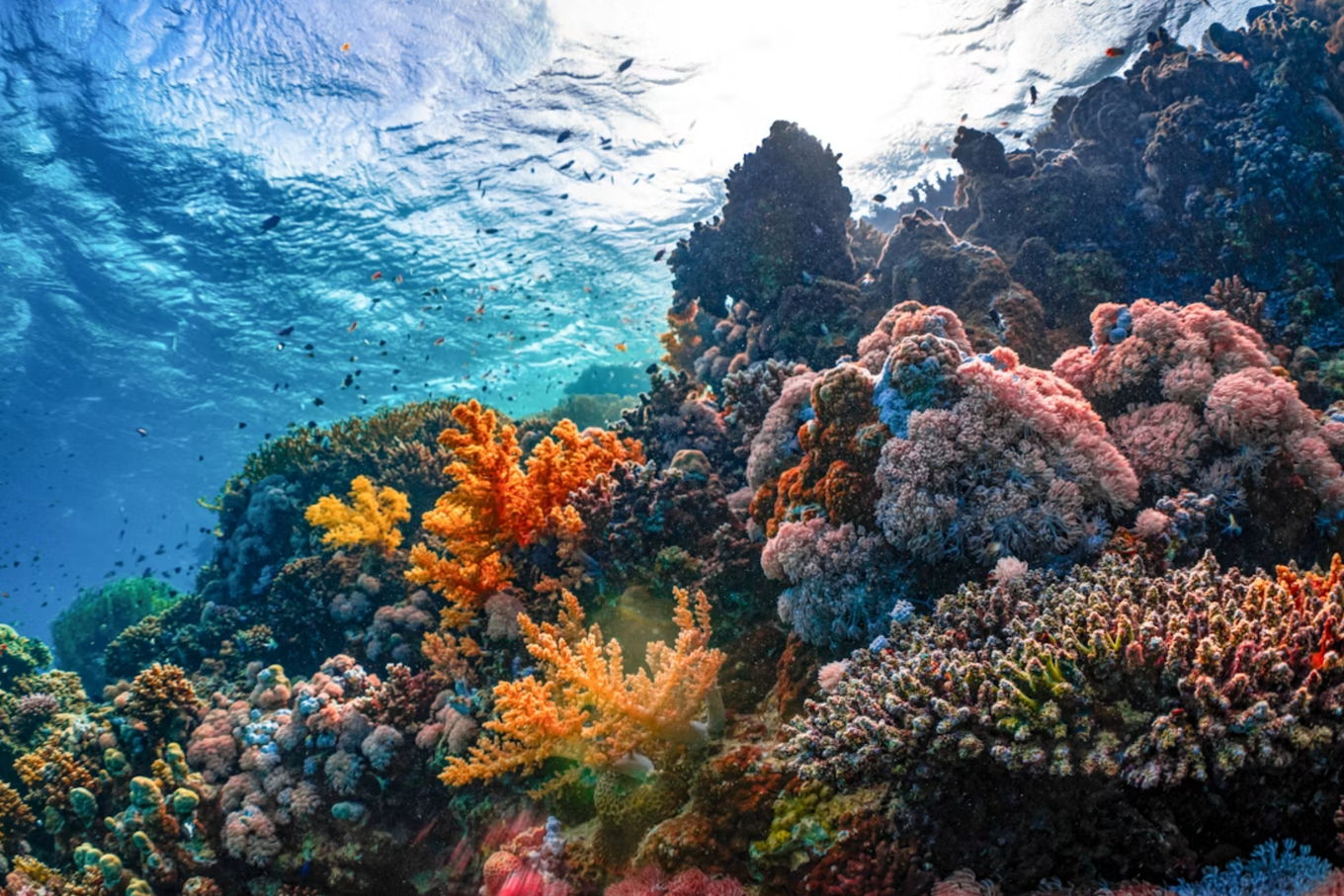
Scientists have identified nearly 166,000 square kilometres of coral reef capable of surviving and recovering from climate change, three times more than previously estimated. The findings, published by the Wildlife Conservation Society (WCS) and Macquarie University in Australia, were presented on 16 June at the Our Ocean Conference in Mombasa, Kenya, one of the world’s leading gatherings on marine protection.
Coral reefs cover less than one percent of the ocean floor but sustain roughly a quarter of all marine life and support the food security and livelihoods of nearly one billion people. For years, the dominant scientific outlook has been bleak. The Intergovernmental Panel on Climate Change (IPCC), the UN body that sets the global benchmark on climate science, has warned that between 70 and 90 percent of reefs could die with 1.5 degrees Celsius of warming above pre-industrial levels, and 99 percent at 2 degrees.
A more detailed picture of resilience
The new study challenges that framing. Researchers analysed 45,000 coral surveys alongside decades of climate and ocean data, producing a map 10,000 times more detailed than any previous version. That resolution enabled the discovery of climate-resilient reefs across 71 countries and 100 territories, including parts of the Caribbean and the Pacific and Atlantic oceans not previously recognised for their potential.
The research identifies three distinct ways reefs can persist in a warming world. Some sit in rare ocean cool spots that shield corals from extreme heat. Others contain coral species that have developed biological adaptations enabling them to withstand bleaching events. A third group functions as recovery refugia: reefs with sufficient ecological health to bounce back after damage. Bleaching occurs when ocean temperatures rise sharply, causing corals to expel the algae that give them both colour and nutrients, often leading to mass die-offs.
“Coral reefs are often framed as ecosystems beyond saving. This research shows otherwise: we know where the hope is and what we need now is political will.” — Emily Darling, Director of Coral Conservation, WCS
A tool for triage, not just optimism
More than half of the climate-resilient reefs identified are concentrated in just five countries: Australia, the Bahamas, Cuba, Indonesia, and the Philippines. Yet only 28 percent of the priority reefs currently fall within protected or conserved areas, leaving more than 119,000 square kilometres outside existing conservation frameworks. Scientists say the new data gives governments a concrete basis for deciding where to direct limited conservation funding, and where, difficult as it is, to accept that some reefs may be too degraded to save.
The research arrives at a precarious moment. Mass bleaching events are becoming almost annual occurrences, and Australia’s weather bureau has warned that a potentially powerful El Niño weather pattern could intensify in the second half of 2026. El Niño brings an intensified warming of Pacific Ocean temperatures, and mass bleaching typically follows. The study also comes as governments worldwide work to meet the so-called 30 by 30 target, a global commitment to place 30 percent of land and marine environments under formal protection by 2030.
“The way we see coral responding to heat events is more nuanced than we previously thought.” — Stacy Jupiter, Executive Director, WCS Global Marine Program
Local action where global solutions fall short
One example of what targeted local protection can achieve lies just south of Mombasa, on Kenya’s Wasini-Mkwiro island. After a major bleaching event in 2024 reduced coral cover in the area from 44 to 27 percent, the reef recovered to 40 percent within a year, according to WCS data. Jesse Kosgei, a WCS marine researcher based in Mombasa, noted that while local communities cannot control global temperatures, preventing destructive fishing and reducing water pollution remain within reach. The findings are funded by the Bloomberg Ocean Initiative and are currently under peer review.
An independent expert welcomed the study’s scope while urging caution about what it can and cannot deliver. Clint Oakley, a coral scientist at Victoria University in Wellington, described the research as heartening, but stressed that reducing carbon emissions remains the most important step for the long-term survival of reefs. The map is a tool for smarter conservation, not a substitute for cutting the emissions that are driving ocean temperatures higher in the first place.
This article is free to read. It always will be — no paywall, no account, no tracking.