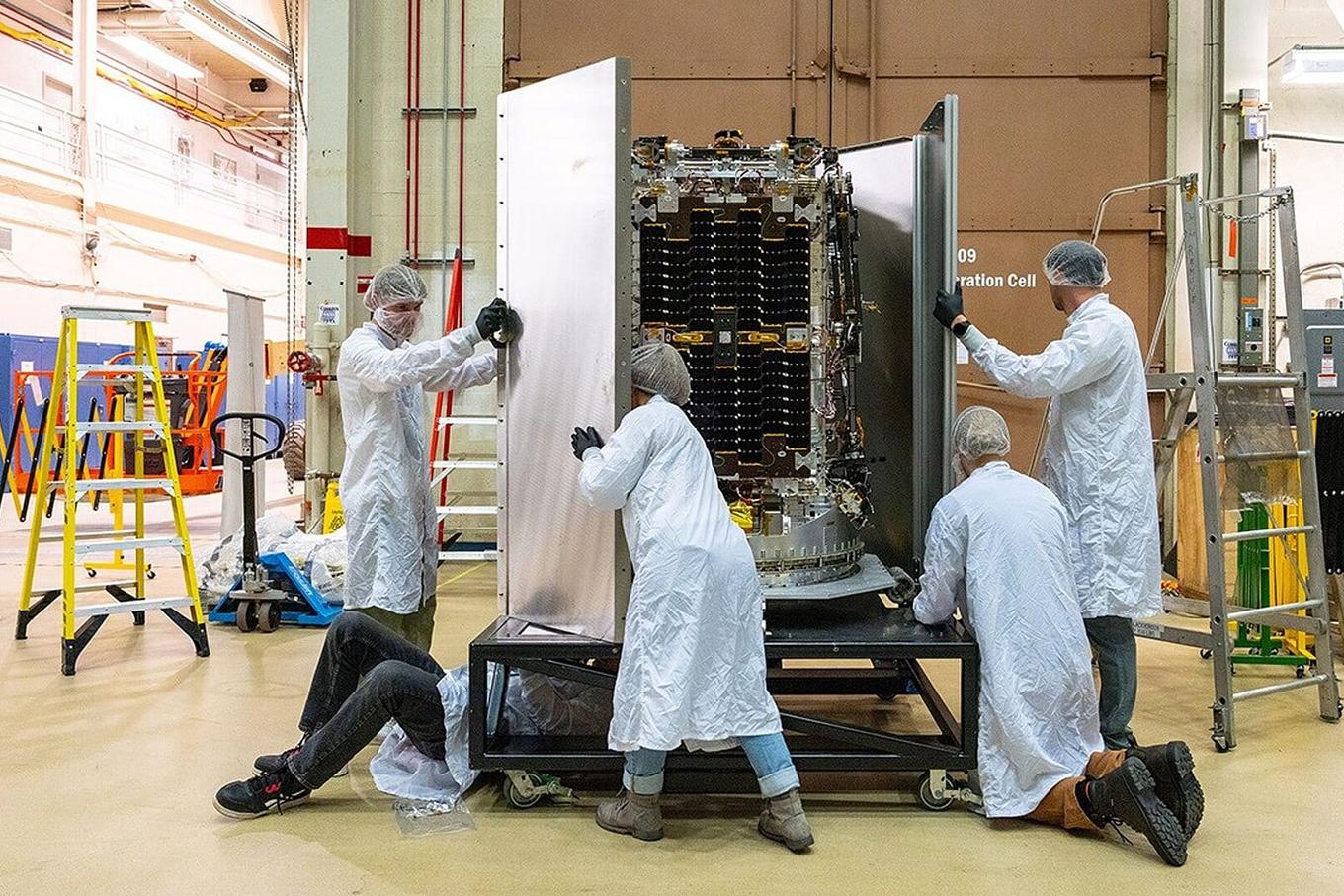
A robotic spacecraft hired by NASA to rescue one of its most valuable orbiting observatories has begun spinning uncontrollably, jeopardising a mission that was already considered technically ambitious. The servicing craft, called LINK, was built by the contractor Katalyst Space Technologies, and it lost its ability to control its orientation over the weekend.
According to NASA, two of the three reaction wheels that control the spacecraft’s alignment have failed, and there are problems with one of the spacecraft’s thruster systems, as reported by TechCrunch. Reaction wheels are spinning discs that let a satellite rotate precisely without burning fuel, so losing two of three leaves a spacecraft with almost no reliable way to point itself.
A satellite too fragile to fix, and too valuable to lose
LINK’s target is the Neil Gehrels Swift Observatory, a NASA telescope that has studied gamma-ray bursts since 2004. Years of atmospheric drag have pulled Swift into a dangerously low orbit, and the observatory has roughly a 50 percent chance of an uncontrolled reentry by mid-2026, according to Gizmodo, prompting NASA to suspend the telescope’s science operations earlier this year to conserve its remaining stability.
LINK launched on 3 July 2026 aboard a Northrop Grumman Pegasus XL rocket, air-dropped from a modified aircraft over the Kwajalein Atoll in the Marshall Islands, in what TechTimes reported as that rocket family’s final flight. The mission was designed to prove that a commercial robot could capture and reboost a government satellite never built to be serviced in orbit, a first-of-its-kind test with implications well beyond Swift.
“If you’re successful, the scientific benefit is tremendous. It’s almost like a new mission, but you’re getting it for just a fraction of what it would cost to actually build something from scratch and fly it,” Swift’s principal investigator Brad Cenko of NASA’s Goddard Space Flight Center told Scientific American.
The fix and the problem run through the same hardware
Engineers now face an awkward complication: the tool needed to stop LINK’s spin is the same system meant to carry out the eventual rescue. Ground teams are attempting to halt the tumble using the craft’s electric thrusters, which ionise xenon propellant and accelerate it to very high exhaust speeds, making them far more fuel-efficient than a conventional chemical rocket engine, though slower to generate thrust, TechTimes reported.
NASA has said LINK remains powered and in intermittent contact with controllers, with its other core systems functioning as expected, according to Gizmodo’s reporting on the agency’s update. Once the spin is arrested, Katalyst has indicated it plans to reassess the spacecraft and reconfigure its navigation and control software to operate with only one working reaction wheel, rather than the three it was designed to use.
Why this matters beyond the United States
The episode is being watched closely in Europe, where the European Space Agency and companies such as Switzerland’s ClearSpace and the UK-based Astroscale are developing their own in-orbit servicing and debris-removal technology. LINK was conceived partly as proof that commercial robots can safely rendezvous with satellites never designed for servicing, a template that European agencies and firms are also pursuing for their own ageing or defunct spacecraft.
A failure at this stage would not only threaten Swift, a telescope still valued by astronomers studying some of the universe’s most powerful explosions, but could also inform debates in Brussels and among European regulators about the reliability of commercial satellite-servicing contracts, as space agencies on both sides of the Atlantic increasingly outsource costly maintenance work to private companies.
This article is free to read. It always will be — no paywall, no account, no tracking.