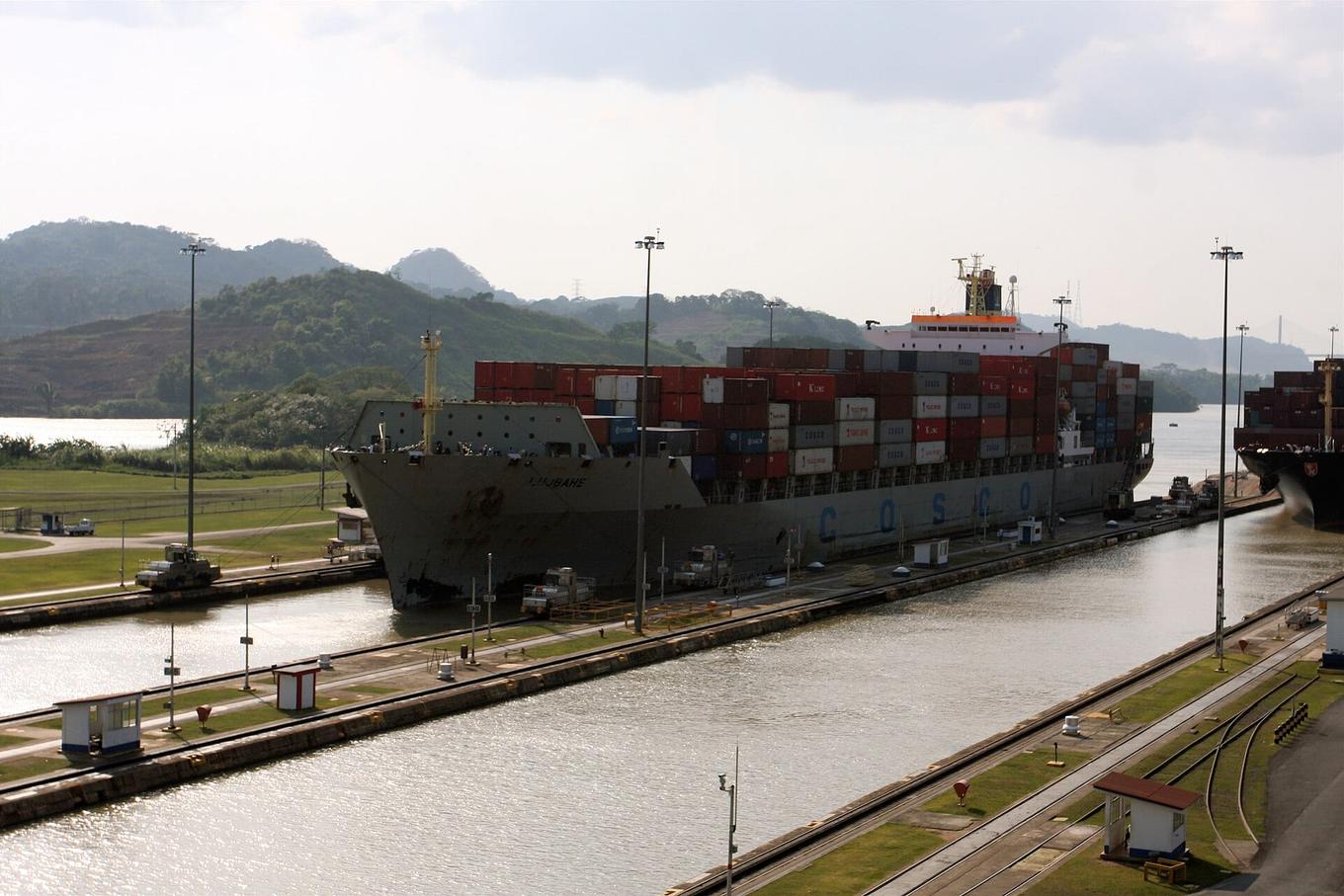
Shipping companies are paying record sums to get their vessels through the Panama Canal, as a conflict thousands of miles away in the Middle East reshapes global trade routes. Auction prices for priority transit slots have climbed past $1 million on average, with the highest bids reaching close to $4 million for a single crossing.
A war closes one waterway, and squeezes another
The immediate trigger is the war involving Iran, which has effectively closed the Strait of Hormuz, the narrow passage between Iran and Oman through which a large share of the world’s oil and gas normally travels. With that route unusable, tankers carrying liquefied natural gas (LNG) and liquefied petroleum gas (LPG) from the United States to Asia are increasingly routed through the Panama Canal instead.
That shift has collided with a separate, longer-running problem: drought. Bloomberg reported that the container ship Seaspan Benefactor recently bid nearly $4 million to cut a queue that had stretched to more than a week, as vessels sought alternative routes because of the Iran war. According to the Financial Times, cited on NPR, the average auction price for an August transit slot at the canal’s main locks reached $1.1 million, more than 16 times the level seen in the same period a year earlier, with fees for the locks that handle the largest ships reaching a record $2.5 million.
The Panama Canal Authority runs two systems for booking a crossing. Most vessels reserve a slot in advance for a fixed fee. A smaller number of slots are instead sold at daily auction, letting operators with urgent, high-value cargo pay to jump ahead of vessels that booked earlier. It is this auction system where prices have spiked most dramatically, as reported by World Cargo News and the Maritime Executive, both of which track shipping industry pricing data.
Drought adds a second squeeze
Even without the disruption in the Middle East, the canal was already under strain. Reporting from trade outlet gCaptain describes how the Panama Canal Authority has cut the maximum permitted draft, the depth a ship can sit in the water while still clearing the lock floor, at its Neopanamax locks amid a developing El Niño weather pattern that threatens to lower water levels in Gatun Lake, the reservoir that feeds the canal’s locks.
“You can skip the queue but it’s immensely costly. When you add the regular fee you’re getting close to $3 million to get your ships through,” Oystein Kalleklev, chief executive of shipping company Avance Gas, told investors on an earnings call.
Every transit through the canal’s locks releases millions of gallons of fresh water from Gatun Lake into the ocean. That same lake also supplies drinking water to Panama City, home to roughly half the country’s population, which limits how far the canal authority can push water use even when demand for transits is high. The authority has previously responded to droughts, including a severe one in 2023 and 2024, by cutting the number of daily transits and further restricting how deep ships can sit in the water.
Who is paying, and why it matters for European shippers
The steepest bids have come from operators of LNG and LPG tankers, cargo that loses value quickly if delivery is delayed and where a shipment can be worth tens of millions of dollars. For those operators, paying an extra few million dollars to avoid a week-long wait can still make commercial sense. Container lines carrying general cargo, including goods bound for European retailers, face a tougher calculation, since queue-jumping fees eat directly into already thin margins.
For European importers and exporters, the knock-on effect is likely to show up as longer transit times or higher freight costs on routes that pass through Panama, particularly those connecting US Gulf Coast energy exports with Asian buyers, and container routes linking Asia with the US East Coast that many European-owned carriers also operate. The Suez Canal, long a key route between Asia and Europe, is not directly affected by the Hormuz closure, but any sustained rerouting of global shipping capacity tends to ripple through freight rates worldwide.
The Panama Canal Authority has said the recent price spikes reflect temporary market volatility rather than a permanent shift in its fee structure, and has indicated it could impose further restrictions depending on how water levels and traffic evolve in the coming months.
This article is free to read. It always will be — no paywall, no account, no tracking.