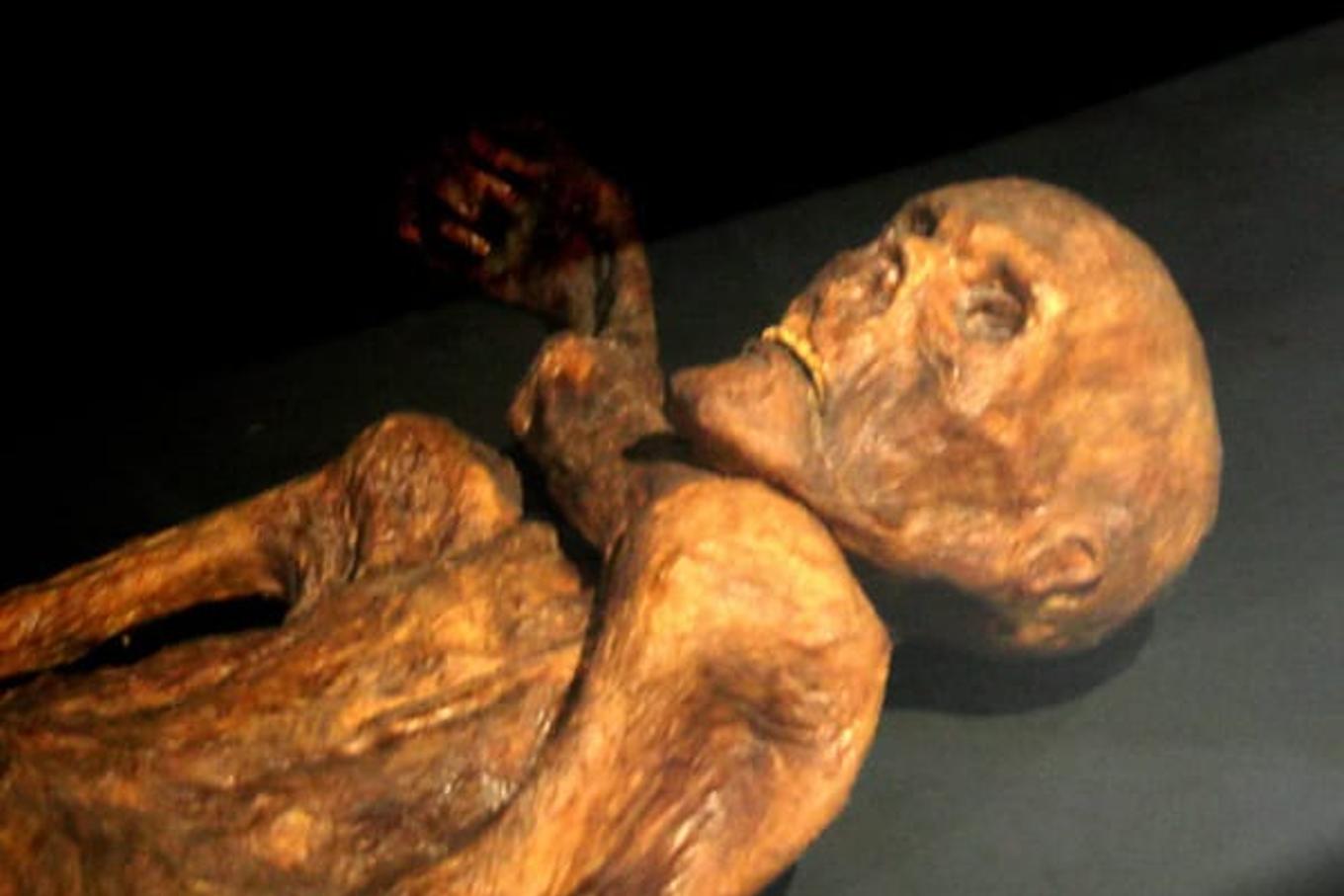
Ötzi the Iceman, discovered frozen in the Ötztal Alps on the Italian-Austrian border in 1991, has spent 5,300 years hosting microbial life. A new study from Eurac Research in Bolzano, northern Italy, has now managed to separate the microbes that lived on and inside him during his lifetime from those that arrived afterwards, during his time in the glacier and during three decades of museum preservation.
The mummy is kept at the South Tyrol Museum of Archaeology in conditions designed to mimic the glacier that preserved him. According to Phys.org, which reported on the same research, the mummy is preserved in a refrigeration chamber at a constant temperature of -6°C and a relative humidity of 99%. Researchers analysed surface ice, meltwater collected from inside the body, and swab samples, combining this with data from earlier studies of his intestines.
Traces of an ancient diet
In samples of internal tissue, the team detected genetic material from bacteria belonging to Ötzi’s original gut flora. Analysis of the microbiome revealed the presence of both ancient gut bacteria, closely resembling those of early human populations, and cold-adapted yeasts likely originating from the glacial environment, as Phys.org summarised.
Study co-author Frank Maixner explained to CNN that these bacterial species have all but disappeared from people in industrialised countries but persist elsewhere. “We identified ancient gut bacteria preserved inside Ötzi that are extremely rare in people living modern, industrialized lifestyles today, though they can still be found in people with traditional, non-industrialized ways of life,” Maixner told CNN in an email. The pattern points to a high-fibre, whole-grain diet unlike that of most people today, a feature also seen in 3,000-year-old preserved faeces from a salt mine in Hallstatt, Austria, one of the only other windows into prehistoric human gut life, according to Phys.org’s coverage of the study.
Yeasts that never really died
Alongside the ancient bacteria, the researchers found something unexpected: four species of cold-adapted yeast, found on Ötzi’s skin, in meltwater from inside the mummy, and in his stomach contents. According to ScienceDaily’s report on the study, these highly specialised organisms are adapted to survive in cold environments, and genetic testing showed that the yeasts are related to strains found in extremely cold places, including Antarctica, supporting the idea that they originated in the glacier and remained associated with Ötzi for thousands of years.
“We see continuity here,” said Frank Maixner, a study co-author at Eurac Research, according to Nautilus.
Remarkably, the team managed to grow living colonies from these yeasts in the lab, something that did not work for the ancient bacteria. Science News reported that the researchers consider the surviving cultures “relicts,” or living time capsules, of Ötzi’s time in the ice after his death, and that the viable cultures suggest Ötzi “is not a static relic but a dynamic biological interface.”
“Our results provide the baseline for future microbial surveys of the Iceman,” Maixner told CNN.
Alpine archaeologist Patrick Hunt of Stanford University, who was not involved in the research, told Science News the conclusion was “right on the mark.”
Why it matters beyond archaeology
The study, published in the journal Microbiome and led by Mohamed Sarhan, Marco Samadelli, Albert Zink and Maixner, has implications beyond understanding one famous mummy. According to Phys.org’s separate report on the paper, cultured strains of the yeast can ferment sourdough and degrade phenol, implying a potential future use in bioremediation.
For the museum in Bolzano, which has cared for Ötzi since his recovery, the findings also carry a practical warning. Researcher Mohamed Sarhan said it is too early to say whether the yeast is harming the mummy, and called for more research, according to Phys.org, underlining that continued monitoring will be needed to keep Europe’s oldest known natural mummy intact for future study.
This article is free to read. It always will be — no paywall, no account, no tracking.