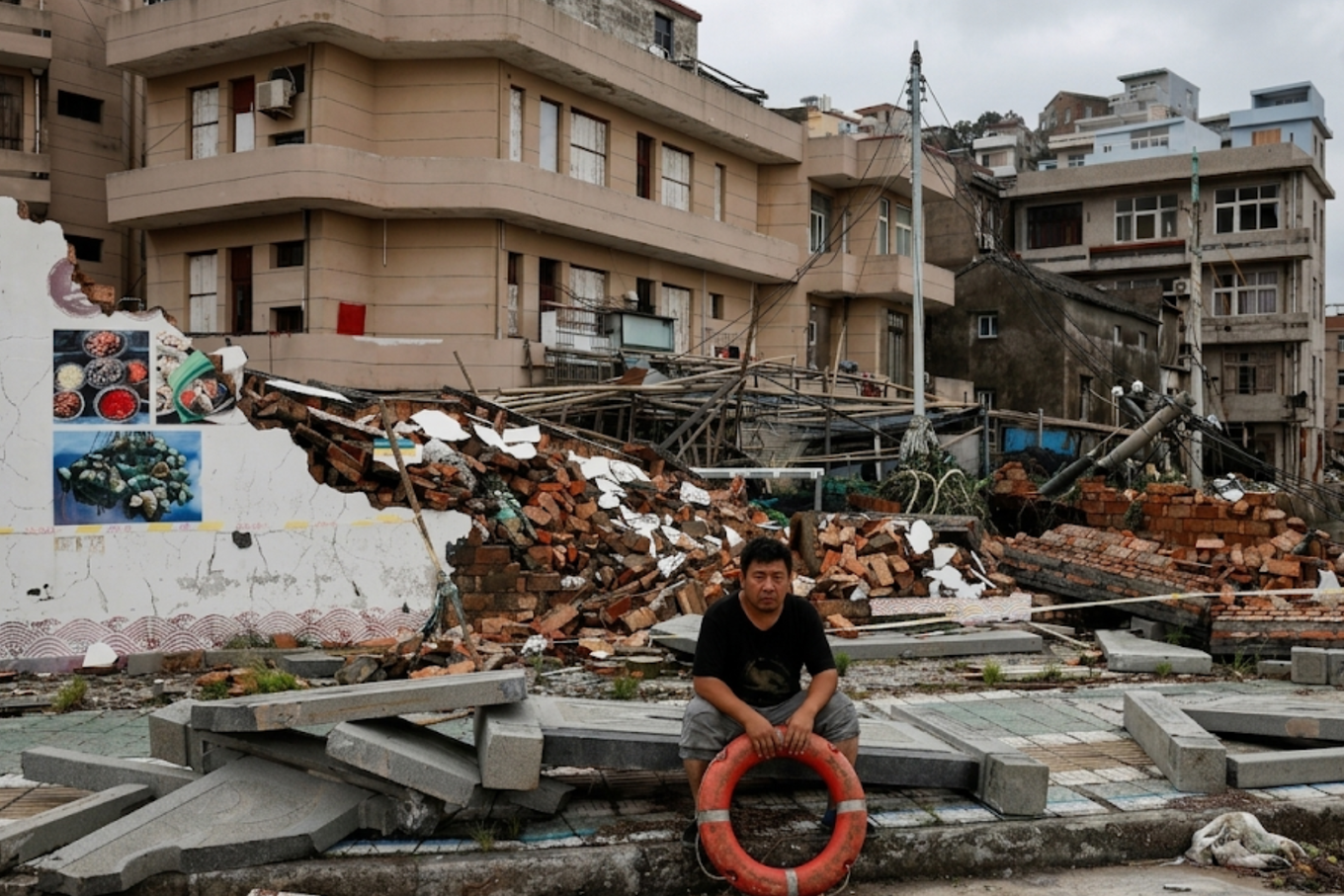
Typhoon Bavi struck the coast of eastern China late on Saturday, making landfall in Yuhuan City in Zhejiang province and leaving a path of destruction across the wider region. By Sunday morning, the storm had weakened to a severe tropical storm, but it continued to push heavy rain and strong winds inland across eastern China.
According to Reuters and the AP, Taiwan’s fire department reported at least 134 people injured as of Sunday morning, up from 113 recorded the previous evening. Most of those hurt were riding motorcycles or bicycles when strong winds and slippery roads caused them to fall. Taiwan’s Central Emergency Operations Center confirmed no fatalities had been reported on the island.
A storm of unusual scale
Bavi was, by some measures, one of the most physically imposing typhoons in decades. The US Joint Typhoon Warning Center described it as over 1,000 kilometres wide at its widest, roughly the width of France. Taiwan’s Central Weather Administration (CWA) said it was the largest typhoon by storm radius to affect the island since 1987, when modern measurement methods were introduced.
“Storms of this size have been fairly rare in recent years,” Jason Chang, a CWA forecaster, told Reuters, adding that the storm’s greatest impact was felt in northern areas such as Yilan and Keelung.
The storm passed north of Taiwan rather than making a direct landfall, but the difference was largely academic for many residents. More than 14,600 people were evacuated across the island, including thousands from the mountainous eastern county of Hualien and the central city of Taichung. Power was cut to more than 234,000 households, and offices, schools, and businesses suspended operations across northern Taiwan for Saturday and into Sunday.
China evacuates nearly two million
On the mainland, the scale of the emergency response was vast. Chinese authorities evacuated more than 1.7 million people ahead of landfall, according to PBS News. Neighbouring Fujian province alone moved more than 100,000 residents and deployed over 17,000 emergency rescue personnel. Shanghai evacuated around 34,000 residents as the typhoon’s outer rain bands reached the city. China’s National Meteorological Center issued the country’s first Red Rainstorm Warning of 2026 alongside an Orange Typhoon Warning.
Bavi is the second typhoon to strike China in just over a week. Typhoon Maysak made landfall in southern China on 3 July, killing at least 39 people. Scientists and forecasters have noted that this season’s unusual activity is consistent with the emergence of an El Niño pattern, which raises sea surface temperatures and can fuel more intense and longer-tracking storms.
“Some loss of wind intensity is anticipated, but Bavi will remain a dangerous storm as it impacts Taiwan and eastern China,” Jason Nicholls, an expert at commercial forecasting service AccuWeather, said earlier in the week.
A deadly trail across the Pacific
Before reaching East Asia, Bavi caused significant harm across a wider arc of the Pacific. In the Philippines, where the typhoon is known locally as Inday, it amplified the seasonal southwest monsoon, triggering landslides that killed at least 19 people and left four missing, according to the country’s National Disaster Risk Reduction and Management Council. In Japan’s Okinawa prefecture, five minor injuries were reported and nearly 83,000 people were evacuated. The storm earlier caused extensive infrastructure damage on the US island of Rota in the Northern Mariana Islands, where it struck at peak intensity with winds approaching 290 km/h.
As Bavi moves northwestward across eastern China on Sunday, forecasters expect continued heavy rainfall across Zhejiang, Fujian, and neighbouring provinces, with further rain possible in Jiangxi, Anhui, and Shandong in the coming days. Authorities in all affected areas have urged residents to remain vigilant for flooding and landslides even as the storm’s winds continue to ease.
This article is free to read. It always will be — no paywall, no account, no tracking.