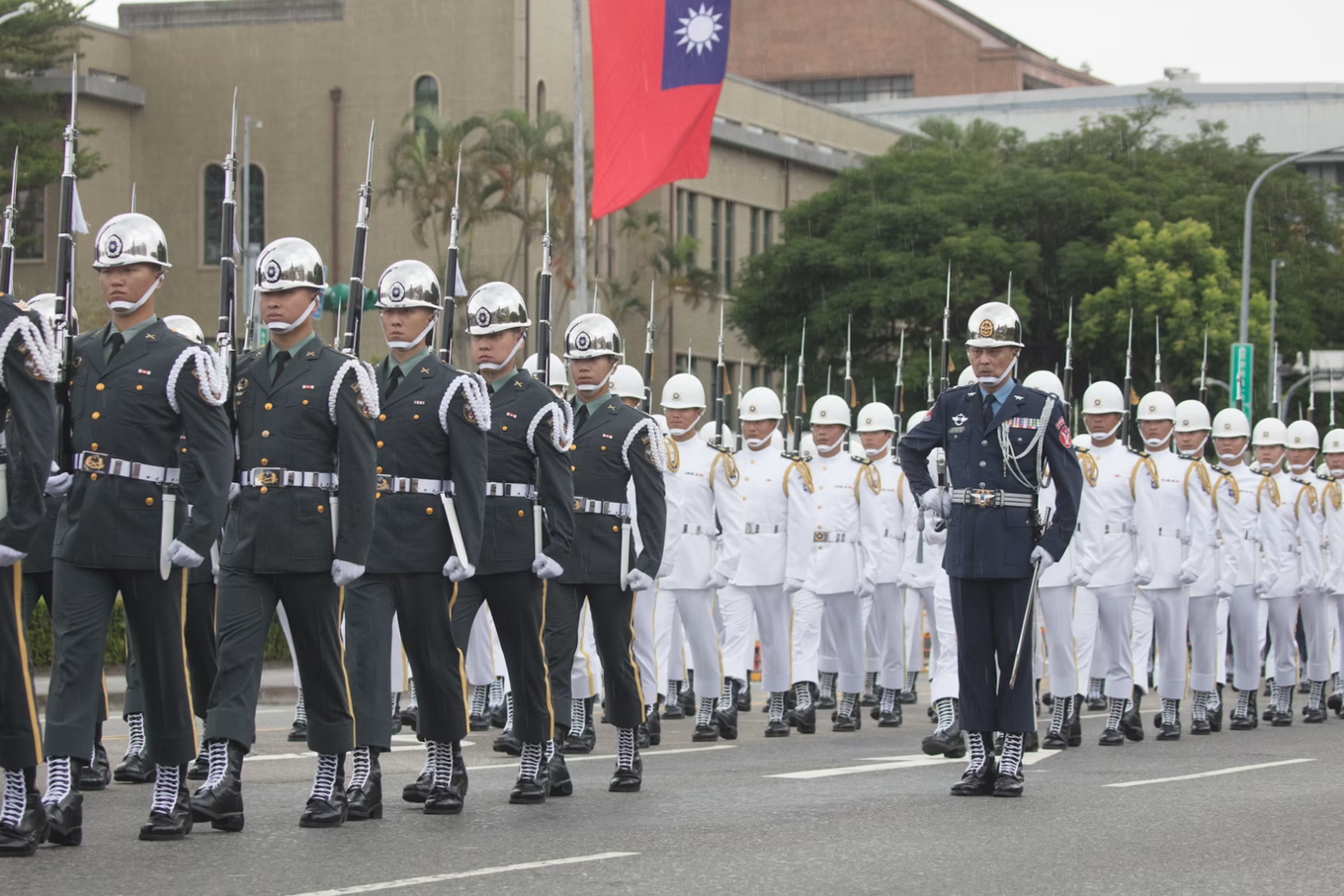
Taiwan’s military has brought back a programme of ‘anti-communist patriotic education’ for its academy graduates, the defence ministry announced on Sunday, ending a pause of more than 25 years. The move reflects a significant hardening of Taipei’s ideological posture toward Beijing at a time of intensifying cross-strait tensions.
According to Reuters, Taiwan’s defence ministry said in a statement that the classes had been restored because of rising military and infiltration danger from China. The curriculum, which targets newly commissioned officers, will be delivered by officials spanning several government bodies, including the Mainland Affairs Council, the body responsible for shaping Taiwan’s China policy, as well as the National Security Council, the Ministry of Justice, and the government’s top think tank, Academia Sinica.
From Cold War relic to present-day policy
During the Cold War, Taiwan’s government routinely warned citizens about the dangers posed by what official rhetoric called the ‘communist bandits’ on the mainland. Formal anti-communist patriotic education for military graduates remained part of that landscape until 2002, when it was stripped of its ideological label and rebranded simply as ‘patriotic education’. Its return now marks a notable rhetorical and institutional reversal.
“It is necessary for them to clearly understand national security threats and recognise the military mission of ‘why we fight, and for whom we fight’,” Taiwan’s defence ministry said in its statement.
The ministry added that the aim of the revived programme was to establish among graduates ‘a clear awareness of friend and foe’. The language is deliberately direct, signalling a shift from the more neutral framing that has characterised Taiwan’s civil-military education since the island democratised in the 1990s.
Record Chinese naval activity sharpens the context
The announcement came as Joseph Wu, secretary-general of Taiwan’s National Security Council, posted on X that Taiwan was tracking a record of more than 110 Chinese military and coast guard ships operating along the first island chain as of Friday. The first island chain is a geographic arc stretching from Japan through Taiwan to the Philippines and Borneo, widely seen as a critical buffer zone in any potential conflict between China and the United States.
“China’s massive maritime mobilisation along the 1st Island Chain is a clear sign of its expansionism,” Wu wrote, describing the concentration of vessels.
On Saturday, China’s coast guard launched a fresh patrol off Taiwan’s eastern coast, drawing a sharp rebuke from Taipei, which insists Beijing has no legal jurisdiction in those waters. China’s defence ministry did not respond to requests for comment. Beijing views Taiwan as its own territory and has never renounced the use of force to achieve unification. Taiwan’s government flatly rejects that claim to sovereignty.
The ideological education drive is one piece of a broader effort by Taipei to shore up its defences. Taiwan’s legislature passed a $24.8 billion, eight-year special procurement budget in May 2026 to buy arms from the United States, and President Lai Ching-te has pledged to raise defence spending to around 3.3 percent of GDP this year. Whether the revival of political education inside the barracks can complement those hardware investments, and how it will sit with a younger generation of Taiwanese officers who have grown up in a democracy with complicated economic ties to the mainland, remains an open question.
This article is free to read. It always will be — no paywall, no account, no tracking.