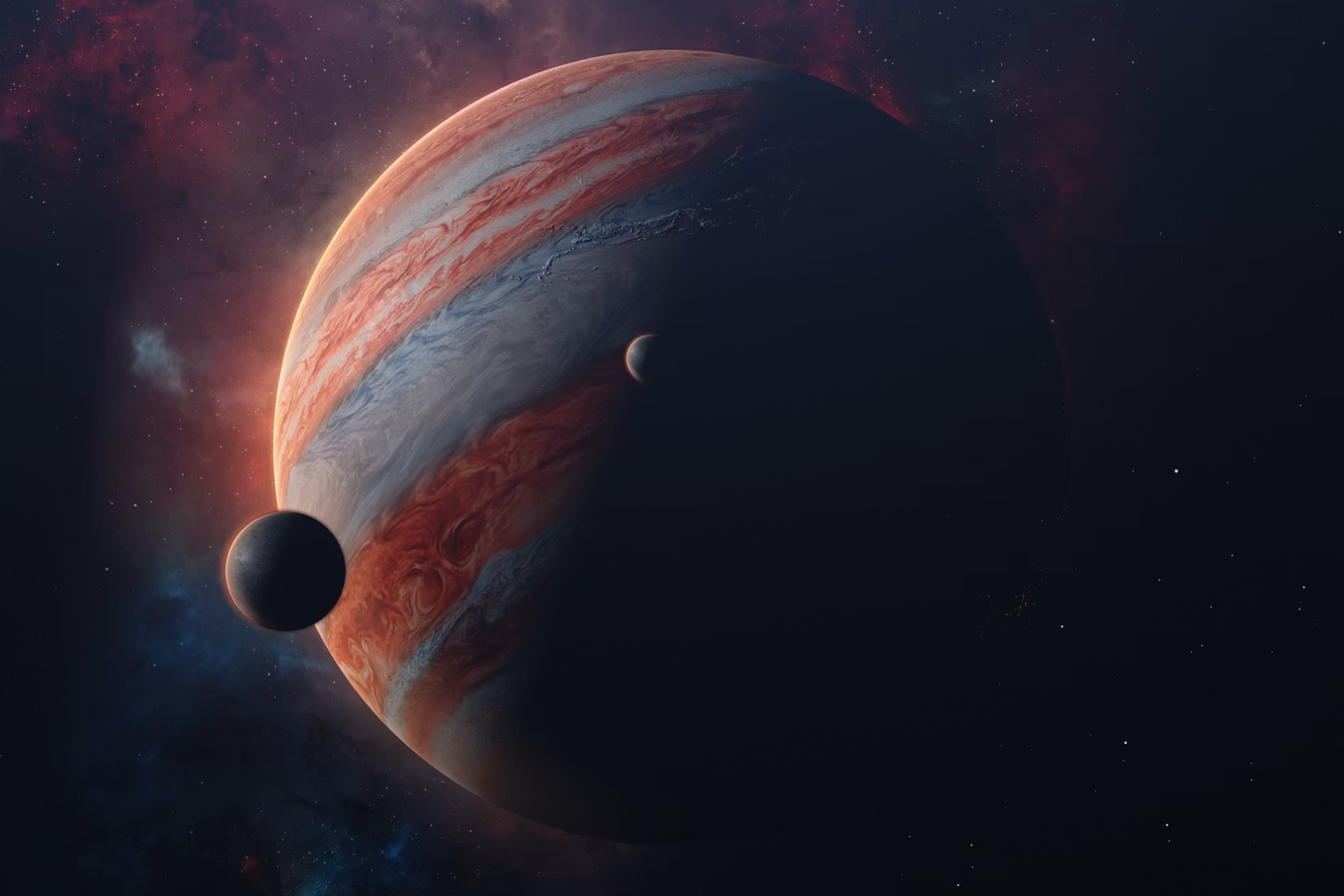
A giant planet that should not exist is orbiting a dead star 80 light-years from Earth, and astronomers now have their best explanation yet for how it got there. Using NASA’s James Webb Space Telescope (JWST), an international research team has analysed the atmosphere, mass, and temperature of the exoplanet WD 1856 b, reconstructing a planetary biography that spans billions of years. Their study was published on 1 July 2026 in the journal Nature.
The white dwarf at the centre of this story is what remains after a Sun-like star exhausts its nuclear fuel, swells into a red giant reaching more than 100 times its original size, and then sheds its outer layers. What is left behind is an Earth-sized, extraordinarily dense stellar core that slowly cools over billions of years. WD 1856 b orbits that remnant once every 34 hours, at a distance of less than 3 million kilometres, roughly 50 times closer than Earth sits to the Sun. At that proximity, the planet should have been vaporised during the red giant phase. It was not.
A planet larger than its own star
The size relationship between WD 1856 b and its host is extraordinary. While stars are almost always vastly larger than their orbiting planets, the opposite is true here. “The planet is about the size of Jupiter, but the white dwarf it orbits is the size of Earth, so the planet is seven times larger than its star,” said Ryan MacDonald, lecturer in extrasolar planets at the University of St Andrews in Scotland and lead author of the study. The planet’s mass is estimated at roughly eight times that of Jupiter, and it sits inside a triple star system in the constellation Draco, adding further gravitational complexity to an already unusual arrangement.
When JWST observed WD 1856 b transiting, or passing in front of, its host star, light filtering through the planet’s upper atmosphere revealed its chemical fingerprint. Researchers detected cloud particles and hydrocarbons, most likely methane. According to Cornell University co-author Victoria Boehm, this marks the first time an atmosphere has been detected on a planet transiting a dead star. The roughly 7% methane concentration points to a carbon-enriched hydrogen atmosphere consistent with a planet that formed in the cold outer reaches of its system, far beyond what planetary scientists call the water and carbon monoxide ice lines.
“We saw the telltale signatures of small cloud particles and hydrocarbons, most likely methane, which is the first time we have seen an atmosphere on a planet transiting a dead star.” — Victoria Boehm, Cornell University
Heat from a violent past
A key clue emerged from the planet’s temperature. WD 1856 b registers at around 126 degrees Celsius, far warmer than its cold, fading stellar host can account for on its own. By combining JWST measurements with established models of how giant planets cool at predictable rates, Christopher O’Connor of Northwestern University’s Center for Interdisciplinary Exploration and Research in Astrophysics was able to trace the planet’s thermal history backwards in time. The analysis indicated the planet underwent a major heating event between 3 and 5.5 billion years after the star became a white dwarf, long after the red giant phase had ended.
That timeline points to a later inward migration rather than survival of the original engulfment event. Two competing models remain on the table. The first, the engulfment model, proposes that WD 1856 b was swallowed during the red giant phase but survived near the stellar core. The second, the gravitational interaction model, holds that the planet originally orbited at a safe distance and was later pulled inward by the gravitational influence of the two red dwarf companion stars in the system. Reuters reported that the abundance of methane in the atmosphere slightly favours the migration theory, since engulfment would likely have diluted that gas by drawing in hydrogen from the expanding star.
“Our results show that stellar death is not the end — some planets experience a vibrant and lively future after the death of their star.” — Ryan MacDonald, University of St Andrews
A preview of our solar system’s distant future
For researchers and readers alike, the most resonant dimension of this discovery is what it implies for our own cosmic neighbourhood. In approximately five billion years, the Sun will exhaust its hydrogen fuel, expand to engulf Mercury, Venus, and possibly Earth, and ultimately collapse into a white dwarf. Whether the outer planets, Jupiter and Saturn in particular, will survive that transition has been an open question. WD 1856 b suggests that survival is possible, and that a planet’s story does not necessarily end when its star dies. O’Connor noted that while our solar system’s surviving planets would likely drift outward initially, the possibility of a more dramatic inward migration cannot be ruled out. The discovery widens, in a meaningful way, the range of environments in the universe where habitable worlds might eventually be found.
This article is free to read. It always will be — no paywall, no account, no tracking.