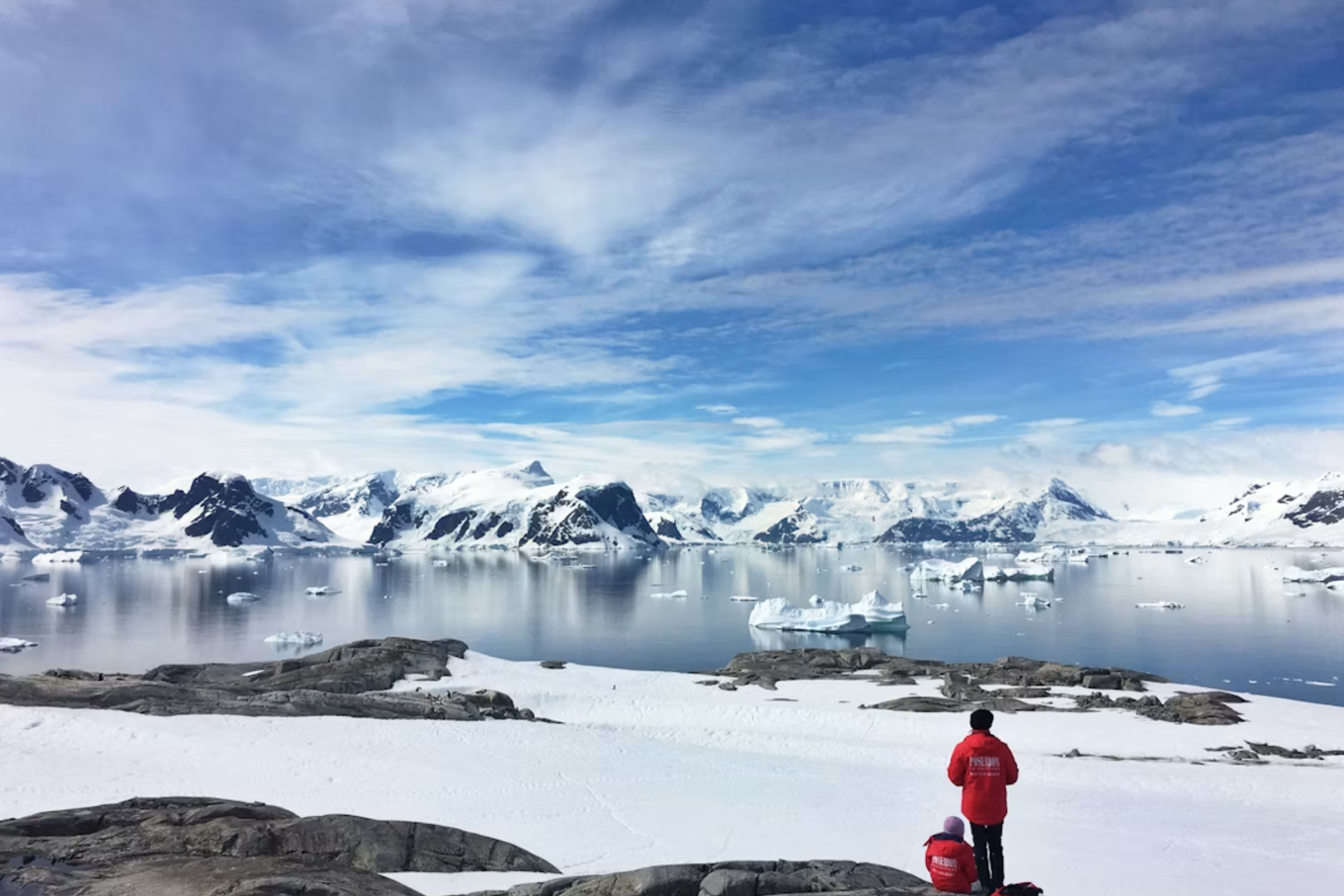
From the surface, Antarctica is deceptive. Its ice sheet — covering roughly 98 percent of the continent and averaging two kilometres thick — presents one of the most featureless landscapes on Earth. But that flatness is an illusion. Beneath it lies a hidden world of alpine mountain ranges, river valleys, pressurised lakes, and life forms that have not seen sunlight since before our species existed.
A continent mapped from space
A study published in the journal Science in January 2026 produced the sharpest picture yet of what lies underneath. An international team of researchers applied a technique called Ice Flow Perturbation Analysis, which uses satellite imagery combined with the physics of ice movement to calculate what shapes must exist below the surface for the ice above to flow the way it does. The result, as Phys.org reported, was a map revealing mountains, deep canyons, and nearly 72,000 hills — more than double previous estimates.
One of the most striking finds was a trench in the Maud Subglacial Basin stretching roughly 400 kilometres across the bedrock — comparable in length to the distance from London to Newcastle. Dr Helen Ockenden of the University of Grenoble-Alpes, the study’s lead author, told the BBC it was like upgrading from a grainy analogue camera to a high-resolution digital image of the continent’s true face.
“It’s like before you had a grainy pixel film camera, and now you’ve got a properly zoomed-in digital image of what’s really going on.” — Dr Helen Ockenden, University of Grenoble-Alpes
The practical stakes are significant. Because current climate models used to forecast global sea-level rise lack detailed information about the terrain the ice sits on, predictions about how fast and where ice will melt remain imprecise. The new map, researchers say, provides a more stable foundation for those calculations and helps identify which sections of the ice sheet are most vulnerable.
Hundreds of hidden lakes, some teeming with life
Beneath the ice, geothermal heat rising from the Earth’s bedrock and friction generated by ice grinding against rock create pools of liquid water in total darkness. More than 400 such lakes are now known to exist. Some are stable; others are active, periodically draining and refilling over months or years, causing the ice surface above them to rise and fall in ways that satellites can detect. A 2025 study led by Sally Wilson, a doctoral researcher at the University of Leeds, used a decade of data from the European Space Agency’s CryoSat-2 satellite to identify 85 of these previously unknown active lakes, raising the known total to 231, and mapping five interconnected lake networks. Wilson noted that the numerical models currently used to project sea-level rise do not yet include subglacial hydrology, a gap these findings are helping to close.
The largest known subglacial lake, Lake Vostok, sits roughly four kilometres below the ice in East Antarctica and is approximately the size of Lake Ontario. Soviet scientists began drilling toward it in 1989, long before they fully understood what lay beneath them. On 5 February 2012, a Russian drill team finally broke through. The pressurised water shot up the borehole and froze before any instrument could be lowered in. When the frozen plug was retrieved the following year, it contained DNA from organisms that had been evolving in complete darkness for millions of years.
Life adapted to the extreme — and what it tells us about other worlds
In August 2025, an international team led by the Korea Polar Research Institute published findings from Mercer Subglacial Lake, buried under 1,085 metres of ice in West Antarctica. Using a clean hot-water drilling system to avoid contamination, the team extracted pristine water and sediment samples. Genomic analysis of more than 1,300 single-cell samples revealed microbial communities genetically distinct from anything found in surface or marine environments — most belonging to species previously unknown to science. The Mercer expedition was only the second time in history that scientists had accessed a subglacial lake without contamination, following the sampling of Lake Whillans in 2013, where researchers identified over 4,000 microbial species surviving in darkness for at least 120,000 years.
“Scientists are still curious about what could be living in this mysterious lake buried beneath the ice for millions of years.” — Antarctic and Southern Ocean Coalition
The implications reach beyond Earth. Researchers note that the extreme conditions in these subglacial lakes — total darkness, high pressure, subzero temperatures, and isolation from the surface atmosphere — closely resemble what is thought to exist beneath the icy shells of Europa, a moon of Jupiter, and Enceladus, a moon of Saturn, both of which are considered candidates for extraterrestrial life. Antarctica, in that sense, is also a laboratory for astrobiology. The frozen continent is not simply a subject of climate science. It is, increasingly, a window onto what life can endure — and where else it might exist.
This article is free to read. It always will be — no paywall, no account, no tracking.