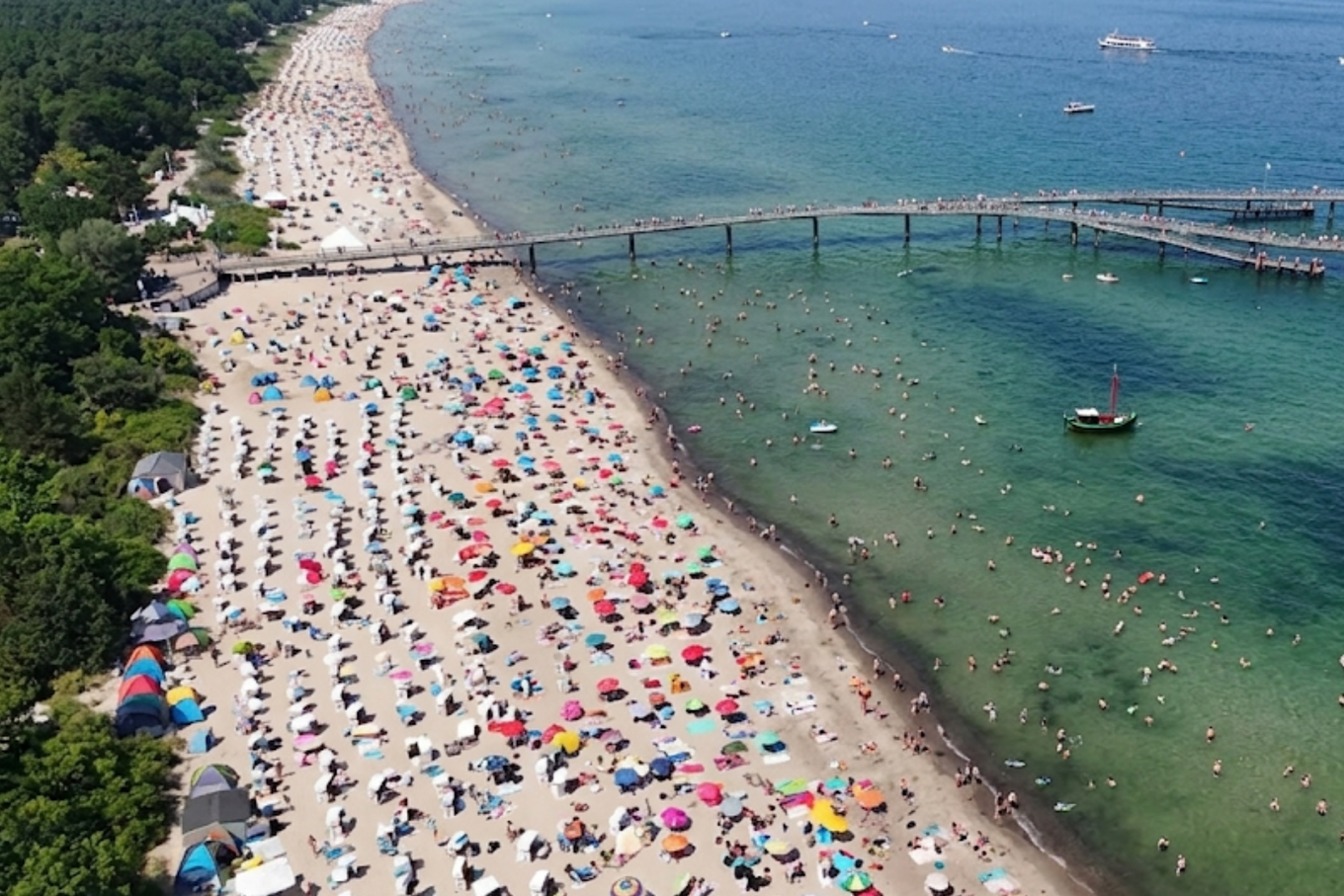
A record-breaking heatwave that has already claimed dozens of lives across Western Europe reached Germany on Saturday, pushing the country to a new all-time temperature high and placing Poland on alert as the heat system continues its eastward march.
Germany’s national weather service, the DWD (Deutscher Wetterdienst), recorded a provisional national high of 41.5°C (106.7°F) at the Drewitz station in eastern Germany on Saturday. That reading broke a record set just 24 hours earlier: 41.3°C recorded in Saarbrücken, near the French border.
An infrastructure built for a cooler climate
The human cost was already visible. In France, dozens of people including both young and elderly died during the heatwave, while temperatures above 40°C disrupted rail travel, power generation, and outdoor events across the region. Italy’s Ministry of Health issued red alerts in 18 cities, among them Rome, Milan, Turin, and Venice. Near Hamburg, one lane of a major motorway was closed after heat cracked the asphalt.
Germany’s national rail operator Deutsche Bahn offered passengers free cancellations on long-distance trips into early next week, citing strain on tracks, signals, and overhead wires from sun exposure, thunderstorms, and wildfire risk. In Poland, state railway PKP Intercity issued similar warnings about deformed tracks and sagging power lines, and offered full refunds for weekend travel.
The heatwave has pushed temperatures up to 18°C above their seasonal average and is being driven by a phenomenon known as an omega block — a weather pattern that traps a bulging mass of hot air over a region for extended periods. (Reuters Climate Monitor)
Poland braces as its own record comes under threat
As temperatures rose well above 30°C across almost all of Poland on Saturday, the country’s Institute of Meteorology and Water Management placed the heatwave peak on 28 and 29 June. Lower Silesia, including the areas of Zgorzelec and Jelenia Góra, was forecast to reach 39°C to 40°C, threatening Poland’s all-time record of 40.2°C, set in Prószków in 1921. Central Poland was expected to exceed 35°C.
Governments across the region were responding with varying urgency. Germany’s Bundestag met on 25 June to debate heat-protection proposals covering city resilience, care facilities, and workplace temperature rules. Warsaw has been developing a national adaptation strategy since a kickoff meeting in March. But the European Environment Agency has noted that 46 percent of hospitals in European cities sit in areas at least 2°C warmer than their regional average, and only 21 of 38 European countries currently have heat-health action plans.
The climate change fingerprint
Scientists said the heatwave would have been virtually impossible without human-caused climate change, which has made this week’s night-time temperatures 100 times more likely than two decades ago.
The broader toll of the event was still being counted. Preliminary all-time temperature records were set on Saturday in Germany, Denmark, and the Czech Republic, and a new June record was registered in Switzerland. Reuters estimated that at least 101 million Europeans faced temperatures above 35°C, including 18 million in Germany and 50 million in France. The most extreme heat was forecast to begin easing over the weekend, with heavy thunderstorms expected on Sunday, before the system’s final impact is felt across Italy, the Balkans, and Eastern Europe into early next week.
This article is free to read. It always will be — no paywall, no account, no tracking.