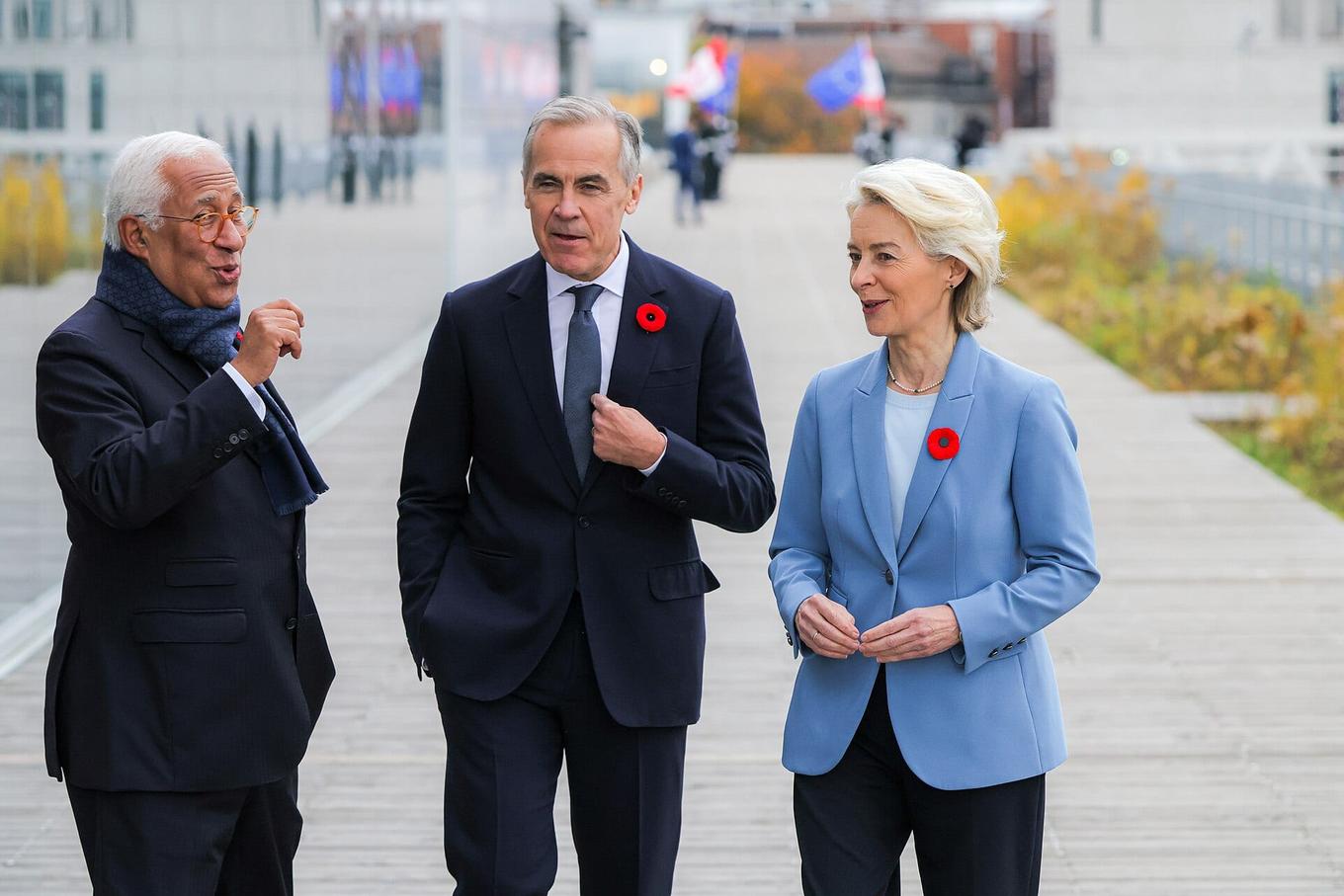
Canadian Prime Minister Mark Carney and two of the European Union’s top officials used a summit in Montreal to announce a new partnership meant to bind Canada and the bloc more closely together, even as the headline idea that drove the talks, making Canada an EU ‘associate member’, failed to survive negotiations intact.
The two-day summit, held on October 29 and 30, 2026, concluded with Carney, European Commission President Ursula von der Leyen and European Council President Antonio Costa jointly launching what they called the ‘Alliance for the Future’, according to the Associated Press. “Today we move toward associate membership for Canada, and we launch a new alliance for the future,” Carney said.
A proposal diluted by member states
Von der Leyen first floated the idea of associate membership for Canada in September 2026, according to CNBC. But the term does not appear in the final summit declaration. Germany, along with France and Greece, objected ahead of the summit, arguing the status lacked a clear legal basis in EU treaties and had not been sufficiently discussed with member states, per IBTimes UK and the brief’s reporting on the talks.
Despite the omission, both Carney and von der Leyen continued to use the phrase in public remarks. “We have worked intensely with all our Member States on this and the basis for associate membership is clear in the summit text,” von der Leyen said, as reported by TIME.
In parallel, and at the foundation, we are working toward the deepest possible partnership, short of accession, because of our geography, with Canada becoming the first Associate Member of the EU.
Carney has repeatedly ruled out full EU accession for Canada, and said any enhanced partnership would need approval from Canada’s Parliament. He told reporters he expects negotiations to wrap up around June, with officials aiming for deeper ties by 2027, according to the Washington Times and CBC News.
Trade, energy and infrastructure deals
Beyond the headline framing, the summit produced concrete agreements. The two sides concluded a Canada-EU Competition Agreement covering consumer goods and technology, and agreed to study the feasibility of exporting Canadian liquefied natural gas to Europe. They also agreed to explore new undersea cables linking Canada, Europe and Asia, and Canada will join a European supercomputing initiative, with plans to connect Canadian financial infrastructure to Europe’s fast-payment systems.
Both sides framed the alliance as a response to reduced reliance on the United States under President Donald Trump, whose tariff threats and trade disputes have unsettled allies on both sides of the Atlantic. “It allows us to withstand shocks,” Carney said, according to ABC News. Von der Leyen echoed the sentiment: “As Mark Carney has said, the international order will also be built from Europe, with Canada as part of it.”
Trump, for his part, warned before the summit that he would view closer Canada-EU ties as provocative. “If they do that, if I think it’s at all a hostile act, I will put very serious tariffs or stop trading with Europe,” he said in September, according to The Hill. Carney dismissed any suggestion that the alliance was cosmetic. “This new alliance is not a marketing exercise,” he said, adding that what matters most to Canadians is “affordability” and “opportunity”.
This article was researched and drafted with AI assistance and reviewed by Lasse Pedersen before publication. How we use AI
This article is free to read. It always will be — no paywall, no account, no tracking.