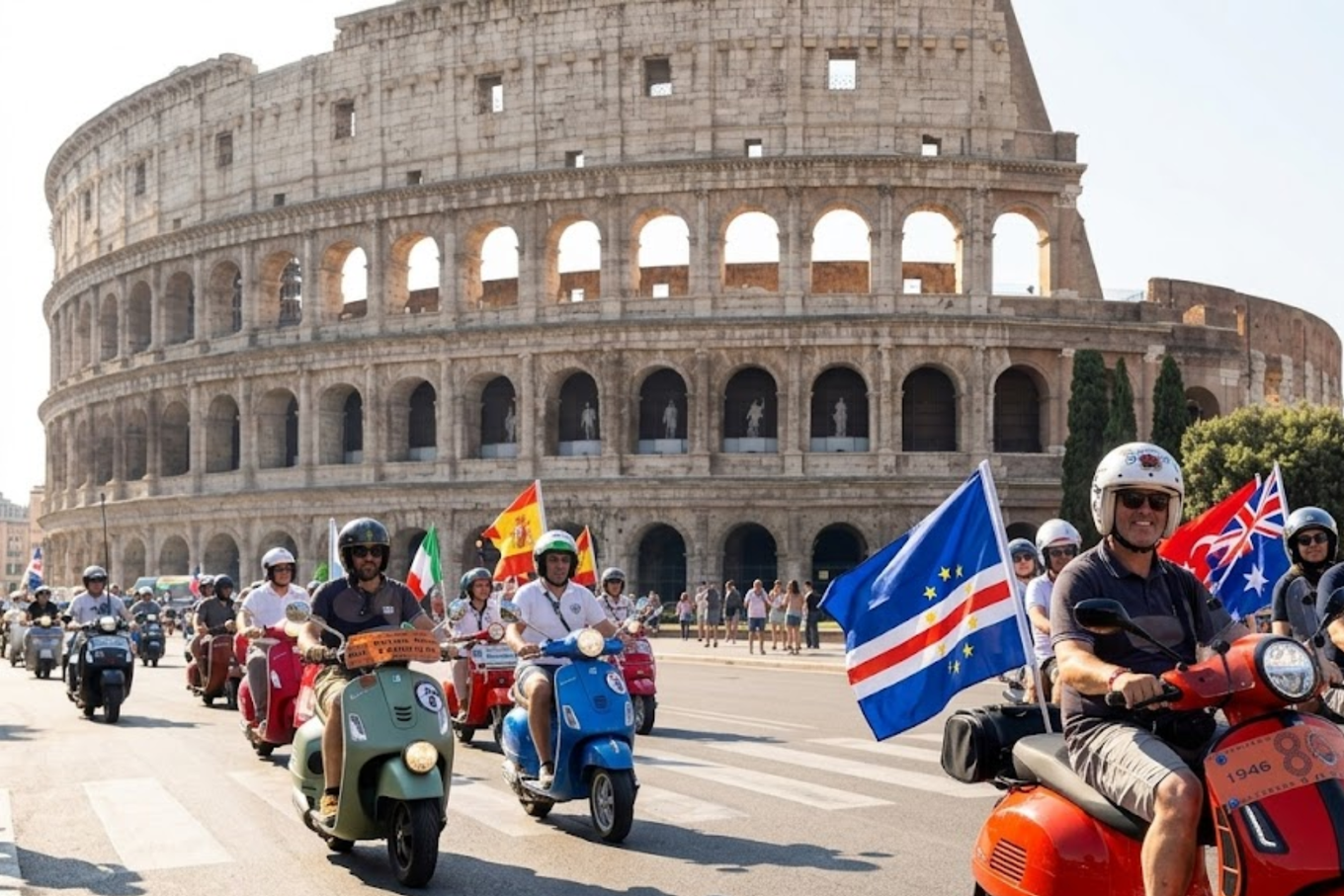
More than 10,000 Vespas buzzed through the heart of Rome on Saturday, weaving past the Colosseum and along the Roman Forum in a grand parade to mark the 80th anniversary of Italy’s most beloved scooter. Riders had arrived from across continental Europe, the United States, Australia, the Philippines, and beyond, turning the Eternal City into a temporary capital of two-wheeled nostalgia.
A village of wasps at the Foro Italico
The hub of the celebrations was the Vespa Village, a pop-up festival site installed inside the Foro Italico complex and its Stadio dei Marmi, a stadium ringed by marble athlete statues from the 1930s. There, visitors browsed 160 models spanning every decade of production, took in a photography exhibition tracing the brand’s stylistic evolution, and watched live performances organised in partnership with Italian radio station Radio Deejay. Admission was free throughout the four-day event, which ran from 25 to 28 June under the patronage of the city of Rome.
Enthusiasts from 60 countries registered their clubs for the event. The sheer variety of machines on show reflected eight decades of incremental refinement: early 98cc models with their bare pressed-steel panels sat alongside the current electric Vespa Elettrica, launched in 2018. The Italian Ministry of Economy and Finance issued a commemorative coin to mark the occasion, and Poste Italiane staged a ceremonial first-day postage cancellation on the opening day.
“The passion for Vespa is for the Italian style, freedom, the ‘60s,” said Natalie Dunand, a retiree from France who happened to be celebrating her own 61st birthday during the parade.
Born from the rubble of the second world war
The Vespa’s origins are inseparable from Italy’s postwar reconstruction. Piaggio, a major aircraft manufacturer based in Pontedera, Tuscany, emerged from the war with its factory destroyed by Allied bombing. Unable to return to aeronautics under the terms of Italy’s armistice, the company pivoted sharply. Enrico Piaggio tasked aeronautical engineer Corradino D’Ascanio with designing a cheap, accessible vehicle for a population navigating bomb-damaged roads. D’Ascanio, who by his own account disliked conventional motorcycles, applied the logic of aircraft engineering to the problem: a monocoque steel body, handlebar-mounted gear controls, and a cantilevered rear wheel that could be removed as easily as an aircraft undercarriage. When Enrico Piaggio first saw the finished prototype, he reportedly exclaimed “Sembra una vespa!” meaning “It looks like a wasp!” and the name stuck.
The patent was filed in Florence on 23 April 1946. Sales began slowly: Piaggio sold around 2,500 units in the first full year, but the introduction of installment payments unlocked mass demand, and annual sales cleared 60,000 by 1950. Hollywood accelerated the brand’s global reach further still. In 1953, Audrey Hepburn rode side-saddle behind Gregory Peck on a Vespa in the film Roman Holiday, shot on location in Rome, and sales topped 100,000 that year. Later appearances in The Talented Mr. Ripley and the animated film Luca cemented the scooter’s status as a cultural shorthand for a particular idea of Italian freedom and style.
Rome’s mayor Roberto Gualtieri said the city was celebrating “an Italian icon that is known and loved all over the world, a scooter that has kept its appeal intact from one generation to the next.”
Nearly 20 million sold, and an electric future
Close to 20 million Vespas have been produced since that first 98cc model, with manufacturing now spread across Italy, India, and Vietnam. Piaggio today sits at the centre of a broader two-wheel group that includes Moto Guzzi and Aprilia, making it the largest scooter and motorcycle manufacturer in Europe. The brand’s design has changed remarkably little: the step-through frame, the enclosed engine, the curved bodywork and the characteristic narrow waist remain recognisable across all eight decades of production. D’Ascanio’s original concept has been described by design historians as belonging to a rare category of objects, alongside the Zippo lighter and the Fender Telecaster, that were so well conceived they simply did not need reinvention.
The festival closes on Sunday 28 June with an Elegance Contest, a parade of rare and prized historic models judged on condition and authenticity. The Vespa Village shuts formally at 3 p.m., after which riders from 60 countries begin the long journey home, carrying with them what the brand has always traded in: the idea, however briefly, that the open road belongs to them.
This article is free to read. It always will be — no paywall, no account, no tracking.