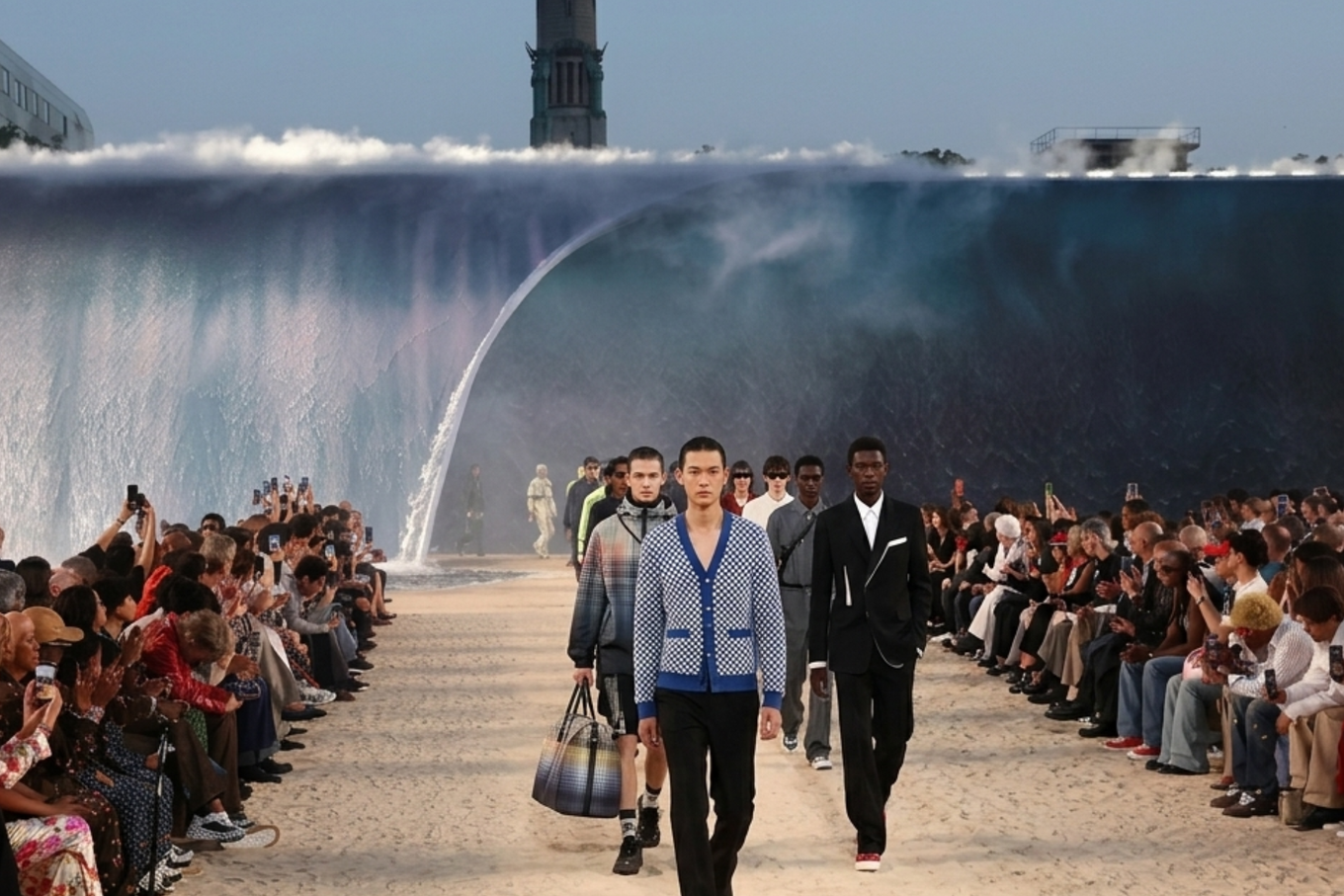
Paris Fashion Week opened on Tuesday with a spectacle that drew as much attention for its setting and timing as for its clothes. Louis Vuitton, the flagship brand of luxury conglomerate LVMH, erected an eight-metre artificial waterfall outside the Cité Universitaire in the south of the French capital, using it as the backdrop for creative director Pharrell Williams’s spring-summer 2027 collection. Outside, temperatures had climbed above 40 degrees Celsius across much of France, the country’s worst heatwave in years.
Images of cascading water set against a sand-covered runway spread quickly on social media. The reaction was swift. Residents of the Cité Universitaire, local politicians, and commentators across Europe questioned whether a luxury brand should stage a water-intensive spectacle in a city where the heat had already become a public health issue.
What LVMH says about the water
LVMH moved quickly to address the criticism. A spokesperson told Reuters that the water came entirely from Paris’s municipal supply, was pumped to the site, and then redirected back into the city’s sewer network via a closed-loop system. In other words, the company says, none of it was consumed or lost to evaporation in a way that differed meaningfully from ordinary urban water use.
“The water used to create the wave comes entirely from Paris’ water supply, which was pumped to the site and then entirely redirected back into Paris’ sewer system via a closed-loop system.” — LVMH spokesperson, via Reuters
Whether that explanation satisfies critics is another matter. The optics of a towering waterfall during a record heatwave proved difficult to separate from the substance of the technical argument. Melody Tonolli, the Paris deputy mayor responsible for student living conditions, said she understood the public backlash.
“I understand the public’s reaction to poorly explained privatisations, with restrictions on access and, in the midst of a heatwave, a display that sends a very unfortunate message.” — Melody Tonolli, Paris deputy mayor
Students say they bore the cost of the spectacle
The Cité Universitaire is not a glamorous venue by design. The 20th-century complex houses around 12,000 students a year and, like many French public institutions, faces mounting financial pressure as state funding shrinks and running costs rise. Its management said Louis Vuitton’s sponsorship helped fund the structure, framing the arrangement as a practical partnership rather than a commercial takeover.
Some of the campus’s residents saw it differently. Several students said they were unable to access certain facilities during the event and had to reorganise their daily routines to work around it, despite continuing to pay rent. One student, Emma Keller, told Reuters the contrast was hard to ignore, calling the juxtaposition of their living conditions and the luxury show “a complete paradox.”
A recurring tension between fashion and the city
This is not the first time a Louis Vuitton show under Pharrell Williams has sparked debate about the use of Paris’s public and civic spaces. His debut show in 2023 closed off the Pont Neuf, the city’s oldest bridge, near the Louvre and Notre Dame cathedral. French politicians at the time accused the brand of appropriating shared public space for commercial ends.
Supporters of Paris Fashion Week argue that high-profile runway events reinforce the city’s global standing as the centre of the fashion industry, and that the economic and reputational benefits justify the temporary disruption. That argument, reasonable in a neutral context, becomes harder to sustain when it collides with a public health emergency and a student population already navigating difficult conditions. The debate is unlikely to end here.
This article is free to read. It always will be — no paywall, no account, no tracking.