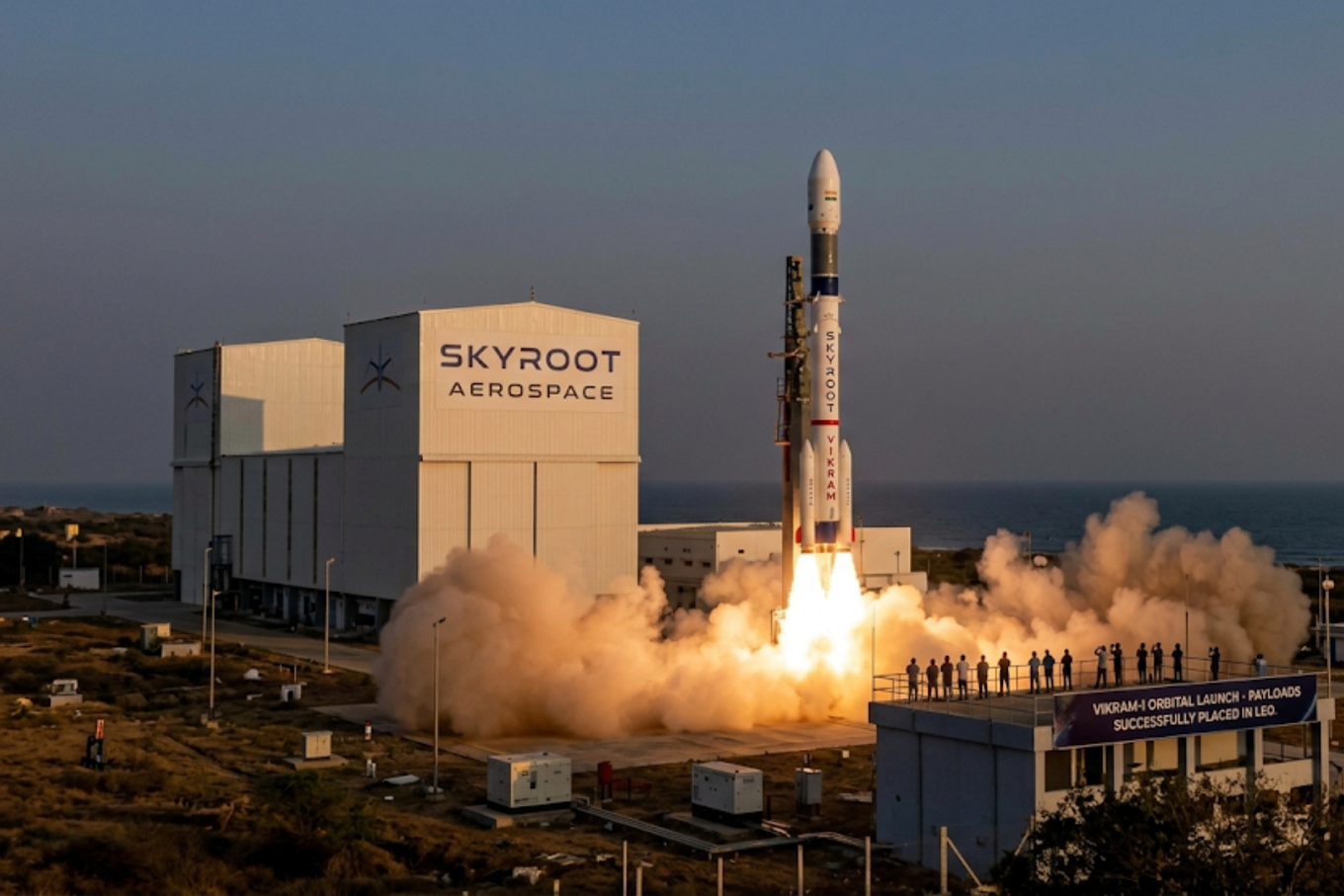
A rocket built by a Hyderabad startup lifted off from India’s Sriharikota spaceport in the early hours of 18 July and reached low Earth orbit 17 minutes later, completing the country’s first fully private orbital mission. Skyroot Aerospace’s Vikram-1, named after Vikram Sarabhai, widely regarded as the father of India’s space programme, deployed four customer payloads at an altitude of approximately 450 kilometres. With that, India joined the United States and China as the only countries where a private company has placed a payload into orbit.
Mission Aagaman, a Sanskrit word meaning ‘the arrival’, carried a performance-monitoring satellite, experimental robotic arms designed to clear space debris, a lab-grown diamond, and a miniature 18-carat gold rocket bearing sculpted likenesses of Indian space and science icons Vikram Sarabhai, physicist C.V. Raman, and former president A.P.J. Abdul Kalam. Reuters reports the mission met all its objectives, with the mission director announcing to cheers in the control room: “The Vikram-1 Aagaman mission is a grand success.”
From a suborbital hop to full orbit in four years
Skyroot was founded in 2018 by Pawan Kumar Chandana and Naga Bharath Daka, both former scientists at the Indian Space Research Organisation (ISRO), India’s government space agency. The company first reached space in November 2022 with Vikram-S, a smaller suborbital rocket that touched the edge of space but did not place anything into orbit. Vikram-1 is a four-stage vehicle roughly the height of a seven-storey building, capable of carrying payloads of up to 350 kilograms into low Earth orbit.
“If an Indian startup can make one of the most challenging things in the space industry, then it gives a huge boost to India’s reputation globally.” — K. Sivan, former chairman of ISRO, speaking to AFP
A regulatory opening six years in the making
The launch did not happen in a vacuum. In May 2020, the Indian government announced that the space sector, previously the exclusive domain of ISRO, would be opened to private enterprise. The Indian National Space Promotion and Authorisation Centre (IN-SPACe) was created shortly afterwards as a single regulatory body to approve and supervise non-governmental space activity. The effect was rapid: India had fewer than ten registered space startups in 2014; by early 2026 it had more than 400, with cumulative investment in the sector exceeding $500 million, including nearly $150 million in 2025 alone, according to Tech Times.
Skyroot itself closed a $60 million funding round in May 2026, co-led by Sherpalo Ventures and GIC, Singapore’s sovereign wealth fund, with participation from funds managed by BlackRock. That round pushed the company’s valuation to $1.1 billion, making it India’s first space-technology unicorn. Total capital raised reached $160 million over eight years of development. The Government of Telangana, the state where Skyroot is headquartered, signed a separate agreement in January 2025 to establish a dedicated private rocket manufacturing and testing facility, with an estimated investment of 5 billion rupees (around $60 million).
“By executing the nation’s first fully private orbital flight, Skyroot has shattered legacy boundaries, demonstrating that our domestic industry is primed to handle end-to-end space missions.” — Lt. Gen. A.K. Bhatt (retired), Director General of the Indian Space Association
Commercial operations targeted for 2027
Saturday’s flight is classified as a test mission, not the beginning of routine commercial service. Skyroot’s co-founder Chandana has said the company plans at least two further test flights before transitioning to commercial operations, with full readiness targeted for 2027. A second Vikram-1 vehicle is already in production across the company’s three Hyderabad campuses, which Chandana says have the capacity to build one rocket per month. Skyroot also signed a memorandum of understanding with US commercial space station developer Axiom Space in June 2025 to explore joint logistics missions to low Earth orbit. Prime Minister Narendra Modi called Skyroot’s founders personally after the mission to offer congratulations, calling the launch “a defining moment in India’s space journey.”
This article is free to read. It always will be — no paywall, no account, no tracking.