Why does anything exist? It is one of the oldest questions in physics, and one of the most unsettling. According to the best theories scientists have, the Big Bang produced matter and antimatter in nearly equal amounts. Yet almost no antimatter remains today. Something, somewhere in the first moments of the universe, tipped the balance — and physicists have spent decades hunting for the mechanism responsible.
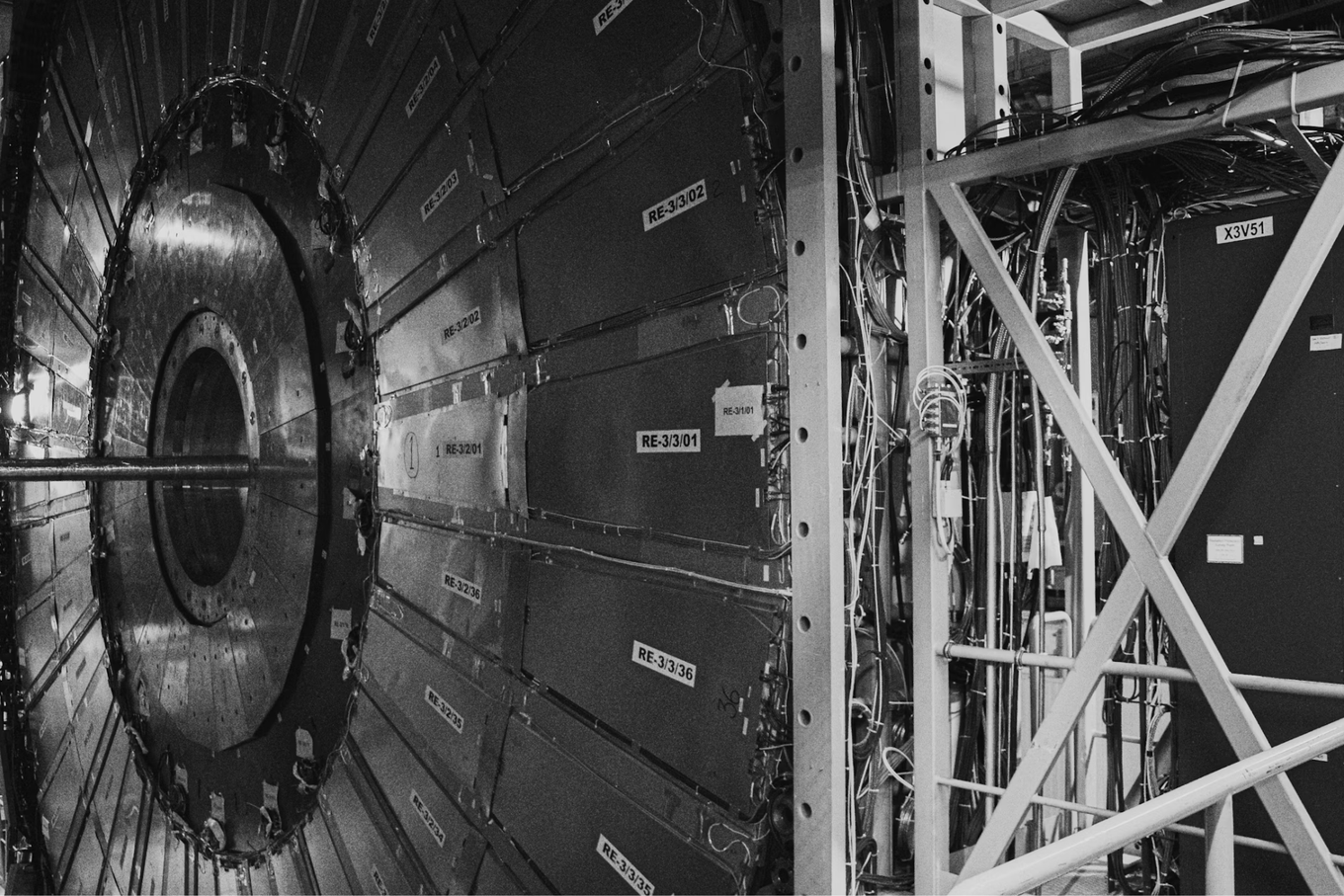
The latest clue comes from Geneva. The CMS Collaboration at CERN’s Large Hadron Collider (LHC) has published new measurements of a phenomenon called charge-parity (CP) violation — a subtle difference in how matter and antimatter particles behave — using the largest sample of beauty mesons the experiment has ever assembled. The results were presented at a seminar at CERN on 14 July 2026.
A record dataset, and a quantum trick
Beauty mesons are short-lived subatomic particles built from a heavy ‘bottom’ quark paired with a lighter quark. What makes them particularly useful for this kind of research is a quantum mechanical quirk: a neutral beauty meson can spontaneously transform into its own antiparticle and back again. By watching how often the matter and antimatter versions decay differently over time, physicists can measure the size of CP violation with great precision.
According to CERN, the CMS team analysed proton–proton collision data collected between 2022 and 2025, reconstructing specific decays of approximately 1.4 million B⁰ mesons — which contain a down quark — and 16,000 B⁰ₛ mesons, which contain a strange quark. Both types decay into a J/ψ meson and a neutral kaon, a decay channel that gives theorists a clean window onto the underlying physics.
“Studying neutral beauty mesons, which are made of a beauty antiquark and a down-type quark, is one of the best ways to investigate CP violation.” — CMS Collaboration
AI does the heavy lifting
A central technical challenge was identifying what type of meson each particle was at the precise moment it was created, before it had a chance to decay or oscillate into its antiparticle. This process, known as flavour tagging, is notoriously difficult at a general-purpose detector like CMS, which was not built primarily for this kind of flavour physics. To overcome this, the collaboration deployed a state-of-the-art machine-learning algorithm that draws on information from muons, electrons, and particle jets recorded in each collision event — and, for the B⁰ₛ meson, from nearby particles produced in the same collision. The approach significantly improved the experiment’s ability to pin down each meson’s initial state.
The B⁰ₛ result is the most precise measurement of CP violation in that decay mode ever made. The accompanying B⁰ analysis cross-checks the same underlying physics using a channel that has been studied since 2001, when experiments in the United States and Japan first confirmed CP violation in beauty mesons. Together, CERN reports, the two results place tighter constraints on possible contributions from particles not yet discovered — particles that would signal physics beyond the Standard Model.
“The measured CP violation is in line with the predictions of the Standard Model, and includes the most precise measurement to date of CP violation in the decay of a B⁰ₛ particle into a J/ψ meson and a neutral kaon.” — CMS Collaboration
What comes next
The results confirm the Standard Model — the theoretical framework that has governed particle physics for half a century — but they do not close the book on the matter–antimatter puzzle. The Standard Model can account for some CP violation, but the amount it predicts is far too small to explain why so little antimatter survives in the observable universe today. That gap remains one of the field’s deepest open problems, and it drives experiments like this one.
The LHC is currently operating in its High-Luminosity phase, which will deliver far larger datasets than Run 3. As those datasets grow, measurements like this one will become progressively more precise, either reinforcing the Standard Model or, researchers hope, revealing the first hairline crack in it that points toward new physics.
This article is free to read. It always will be — no paywall, no account, no tracking.