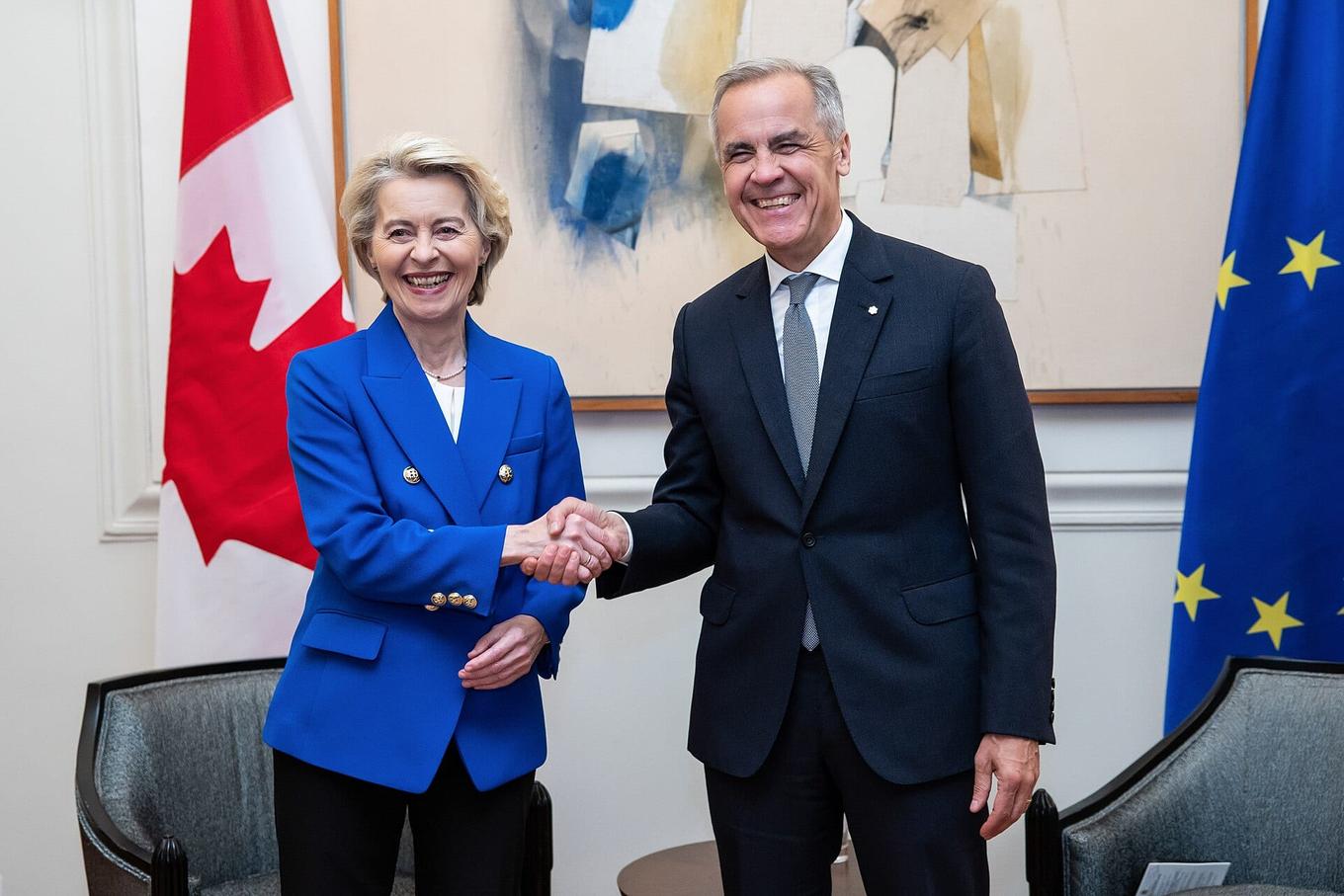
Ursula von der Leyen used her annual State of the European Union address in Strasbourg on Tuesday to propose that Canada become the European Union’s first ever ‘associate member’, a category that does not currently exist under EU treaties.
Canadian Prime Minister Mark Carney sat as a special guest in the European Parliament chamber for the speech and received a standing ovation, according to Reuters, via its republication by Internazionale.
I would like to work with you on opening the door for Canada to be the first associate member of the EU. — Ursula von der Leyen
A trade war pushes Ottawa toward Brussels
The proposal follows a Wall Street Journal report on 13 September, cited by Euronews, that Carney’s government had been exploring associate status with unnamed EU and Canadian officials. Canada’s interest comes amid an escalating trade dispute with the United States, where President Donald Trump has threatened tariffs of 50% on Canadian cars and steel starting in 2027.
Von der Leyen framed the potential partnership broadly, saying it could extend to advanced manufacturing, defence production, the Arctic, energy, critical minerals, batteries, artificial intelligence, quantum computing and cybersecurity, according to the brief’s sourcing from RTE and iNFOnews.ca.
We share one ocean, one set of values, one way of seeing the world. — Ursula von der Leyen
Legal doubts, and an echo of the Ukraine debate
The term ‘associate member’ appears nowhere in EU treaty law, and legal specialists have already voiced scepticism. Steven Blockmans, deputy director of the International Centre for Defence and Security, told Euronews the concept ‘makes no legal sense’ and questioned how such an arrangement would function in practice.
The idea also revives a similar proposal made in May 2026 by German Chancellor Friedrich Merz, who suggested a comparable status for Ukraine as part of a political commitment from EU leaders. That plan was dismissed by Kyiv and most member states, who feared it could become a permanent substitute for full accession rather than a step toward it.
Underlining the slow pace of EU-Canada integration even under existing agreements, the CETA trade deal between the two sides, signed more than a decade ago, still has not been fully ratified by all 27 EU member states.
Von der Leyen cast the outreach to Canada as part of a broader strategic shift for Europe. ‘Partnerships are a strategic choice for Europe. But they also respond to the fracture in the international rules-based system,’ she said, according to Reuters reporting republished by Internazionale.
Carney was expected to address the European Parliament chamber directly on Wednesday, according to RTE. Neither the Canadian embassy in Brussels nor European Commission spokespeople had responded to requests for comment on the associate member concept before von der Leyen’s speech.
This article is free to read. It always will be — no paywall, no account, no tracking.