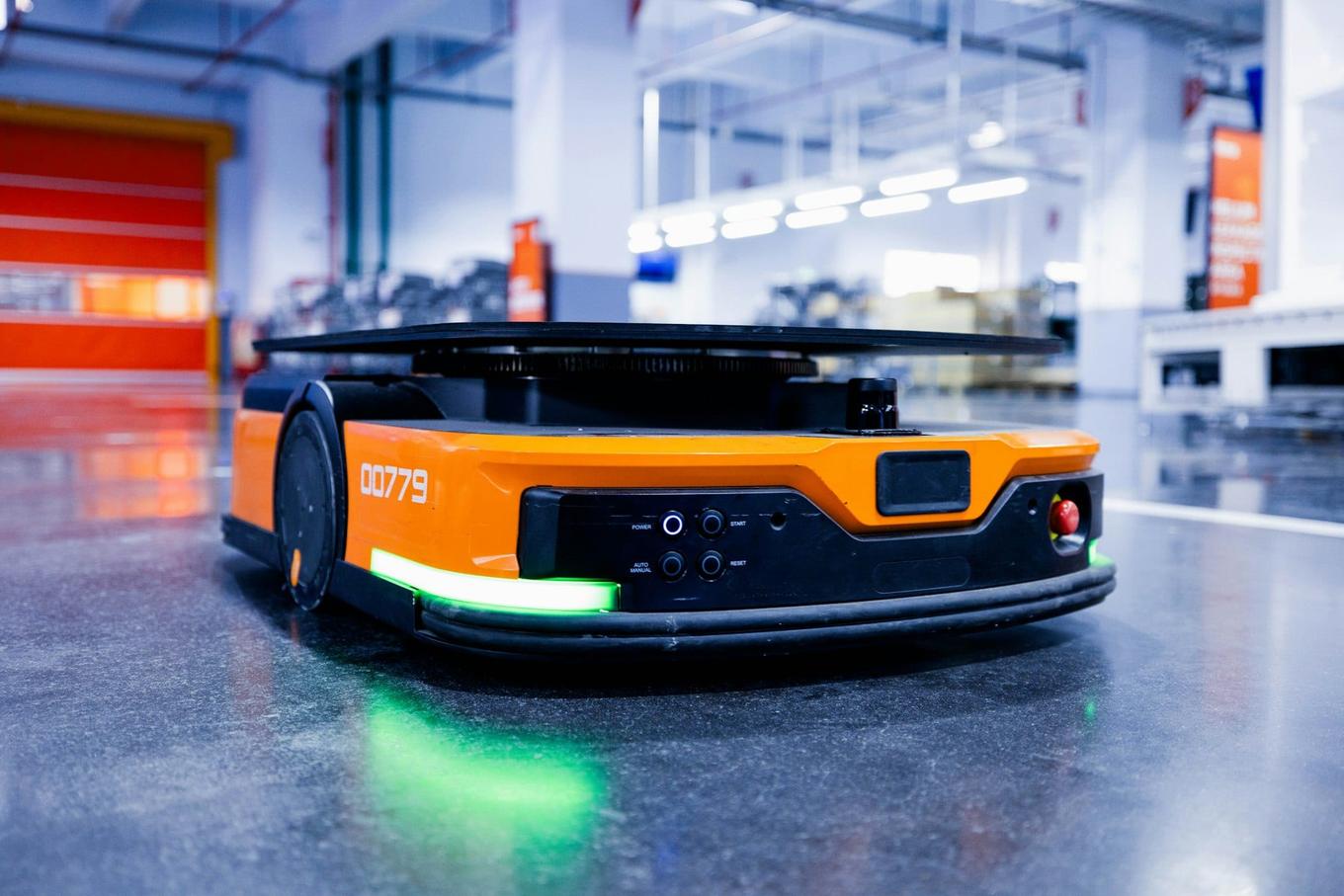
A fleet of squat, silver robots glides beneath storage racks in a British warehouse, lifting shelves and carrying them to workers stationed at fixed picking points. The scene, once a novelty, has become routine in UK distribution centres, and increasingly the machines doing the work come from China.
Tesco, Asda and Next are among the major UK retailers now running on autonomous mobile robot technology supplied by Geek+, a Chinese firm that has become the world’s largest provider of such systems, according to BBC News. The company’s UK deployment partner, MotionTech, has placed more than 2,000 Geek+ robots across 10 warehouse sites in Britain, serving some of the country’s best-known retail names, and the UK is now Geek+’s largest market in Europe.
Filling a productivity gap
Geek+ says automating these repetitive journeys lets retailers increase picking speeds, store more goods in spaces that are hard for humans to reach, and reduce errors. Unlike traditional warehouse automation, which relies on fixed conveyor systems and permanent infrastructure, its autonomous mobile robots can be deployed using little more than QR code floor markers and safety fencing, making them cheaper and quicker to install.
The UK has struggled with weak productivity growth for more than a decade. Combined with a deepening shortage of warehouse and logistics staff, that has left a gap in Britain’s supply chains that Chinese robotics exporters are moving quickly to fill.
Britain’s low adoption of robotics is “surprising” given its manufacturing heritage, the Organisation for Economic Co-operation and Development has said, noting that UK firms have embraced mature digital technologies but lag behind in robotics and automation.
In its 2026 report on SME technology adoption in the UK, the OECD identified robotics as key to lifting Britain’s productivity. It also noted that the UK has one of Europe’s largest e-commerce and logistics sectors, yet many of its warehouses remain in the early stages of automation, a mismatch that has created an opening for suppliers like Geek+.
From electric cars to robot fleets
Geek+’s rise reflects a wider pattern in Chinese manufacturing, where expertise built up in one sector spills over into another. Batteries, electric motors, cameras, sensors and semiconductors originally developed for electric vehicles are increasingly powering China’s robotics industry, creating what one industry analyst described to the BBC as “overlapping industrial ecosystems”.
XPeng, the Chinese electric vehicle maker, illustrates that crossover. The company unveiled a humanoid robot called Iron last year, and its founder He Xiaopeng told the BBC he no longer views the company as simply a carmaker. “We want XPeng to be a high-tech company,” he said, predicting that “in the future, any car company will transform into a car and robotics company.”
Analysts believe China’s robotics push could follow the trajectory of its global success in electric vehicles, using manufacturing scale, dense supplier networks and fast product cycles to build an early lead in export markets. Geek+ itself listed on the Hong Kong stock exchange in 2025, in one of the largest robotics share sales of that year, a sign of investor confidence in the sector’s growth.
Security questions loom over the sector
Not every government is as relaxed about Chinese robotics as British retailers appear to be. In the United States, the Federal Communications Commission has moved to ban imports of new foreign-made humanoid and quadruped robots, arguing the devices could create supply chain vulnerabilities and cybersecurity risks to critical infrastructure. FCC chairman Brendan Carr described the move as an effort to secure America’s critical supply chains, a framing China’s foreign ministry rejected as protectionism disguised as national security policy.
Britain has not introduced an equivalent restriction, and the robots currently working in UK warehouses are wheeled models rather than the humanoid and quadruped machines targeted by Washington’s ban. The UK has, however, shown sensitivity to Chinese-made hardware in other contexts, including reported government concern over Chinese-manufactured drones photographing sensitive infrastructure sites such as power substations and reservoirs.
For now, the economic case for automation appears to be outweighing security caution in Britain’s warehouses. With online retail continuing to grow and logistics operators struggling to fill roles, Geek+ and its rivals look set to find fertile ground in the UK, even as questions about data handling and long-term reliance on Chinese suppliers remain largely unresolved.
This article is free to read. It always will be — no paywall, no account, no tracking.