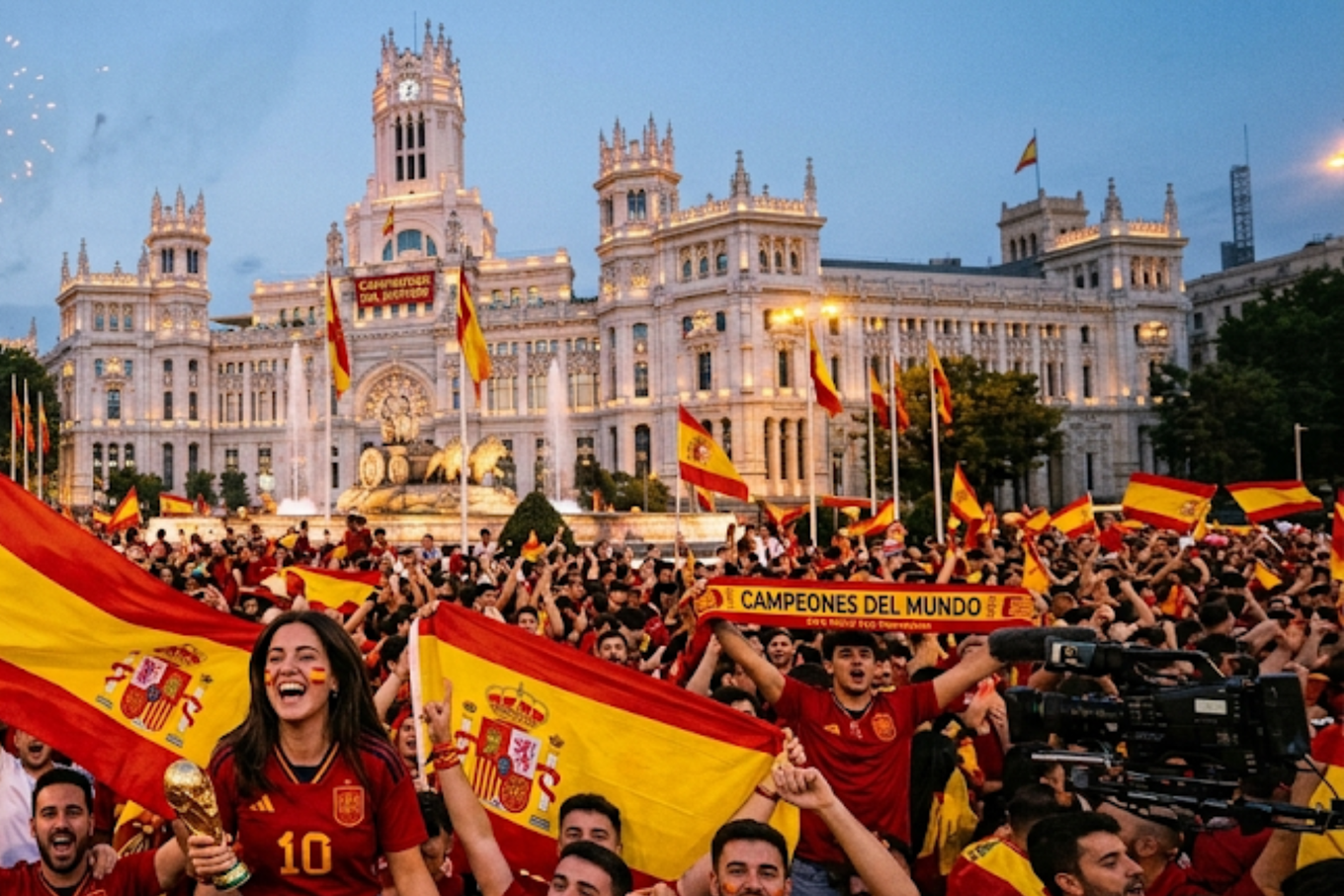
Nearly two years after a serious knee injury threatened to end his career, Rodri lifted the World Cup trophy in New Jersey on Sunday evening. Spain defeated Argentina 1-0 in a tight final at MetLife Stadium, with Ferran Torres scoring the decisive goal in the second period of extra time. The Manchester City midfielder was named the Golden Ball winner, the tournament’s best player award, completing one of sport’s more improbable comebacks.
Rodri ruptured his anterior cruciate ligament, the main stabilising ligament of the knee, during Manchester City’s draw with Arsenal in September 2024. He missed roughly eight months of competitive football, only to suffer further setbacks during his return. A hamstring problem kept him out of nine Premier League matches between November and December 2025, and a groin injury then limited him to just two of City’s final eight league games of the season. There were moments, he admitted, when he questioned whether he would play at this level again.
“There was a moment of doubt where I wondered not just if I would return to my previous level, but if I would ever play again. I’ve proven that I have.” — Rodri
Guardiola’s patience vindicated
Pep Guardiola, who left Manchester City after the 2025-26 season, had warned as early as October 2025 that the club would see a cautious, diminished version of Rodri for most of the domestic campaign. He predicted that the midfielder’s true form would only resurface at the World Cup itself. That prognosis proved accurate. Spain coach Luis de la Fuente restored Rodri to the starting lineup once he was fit, and the 30-year-old grew steadily through the tournament.
“Rodri is the backbone in midfield that makes everything right,” De la Fuente said after Spain’s semi-final win over France.
The quiet force behind a collective machine
Rodri’s contribution rarely showed up in the statistics that attract headlines. He did not score in the tournament. His influence was instead structural: according to Opta Analyst, he completed more passes than any player in the history of a single World Cup, reaching 655 in total. Against France in the semi-finals, he won 11 individual duels, matching the combined total of France’s central midfield pairing of Aurélien Tchouaméni and Adrien Rabiot, and won all four of his aerial challenges. France’s best attacking players, Michael Olise and Kylian Mbappé, failed to exchange a single pass in the first half.
The final against Argentina was harder. Reuters reports that Spain eventually prevailed after extra time, with Torres netting the winner to deny Lionel Messi, widely regarded as the finest footballer in history, a record-extending third Golden Ball. Spain also won the Golden Glove, awarded to goalkeeper Unai Simón, and the Best Young Player prize, taken by 19-year-old defender Pau Cubarsí ahead of his teammate Lamine Yamal.
After collecting the Golden Ball, Rodri spoke directly to younger players watching. “I’m proud and I would love for new generations to see that it is possible,” he said. “That a player who touches the sky and then plummets to hell is also capable of rising again.” With his World Cup medal now alongside his Ballon d’Or, European Championship title, and Champions League winners’ medal, he joins Franz Beckenbauer, Gerd Müller, and Zinedine Zidane in a group of four men to have claimed all four of football’s most prestigious prizes.
This article is free to read. It always will be — no paywall, no account, no tracking.