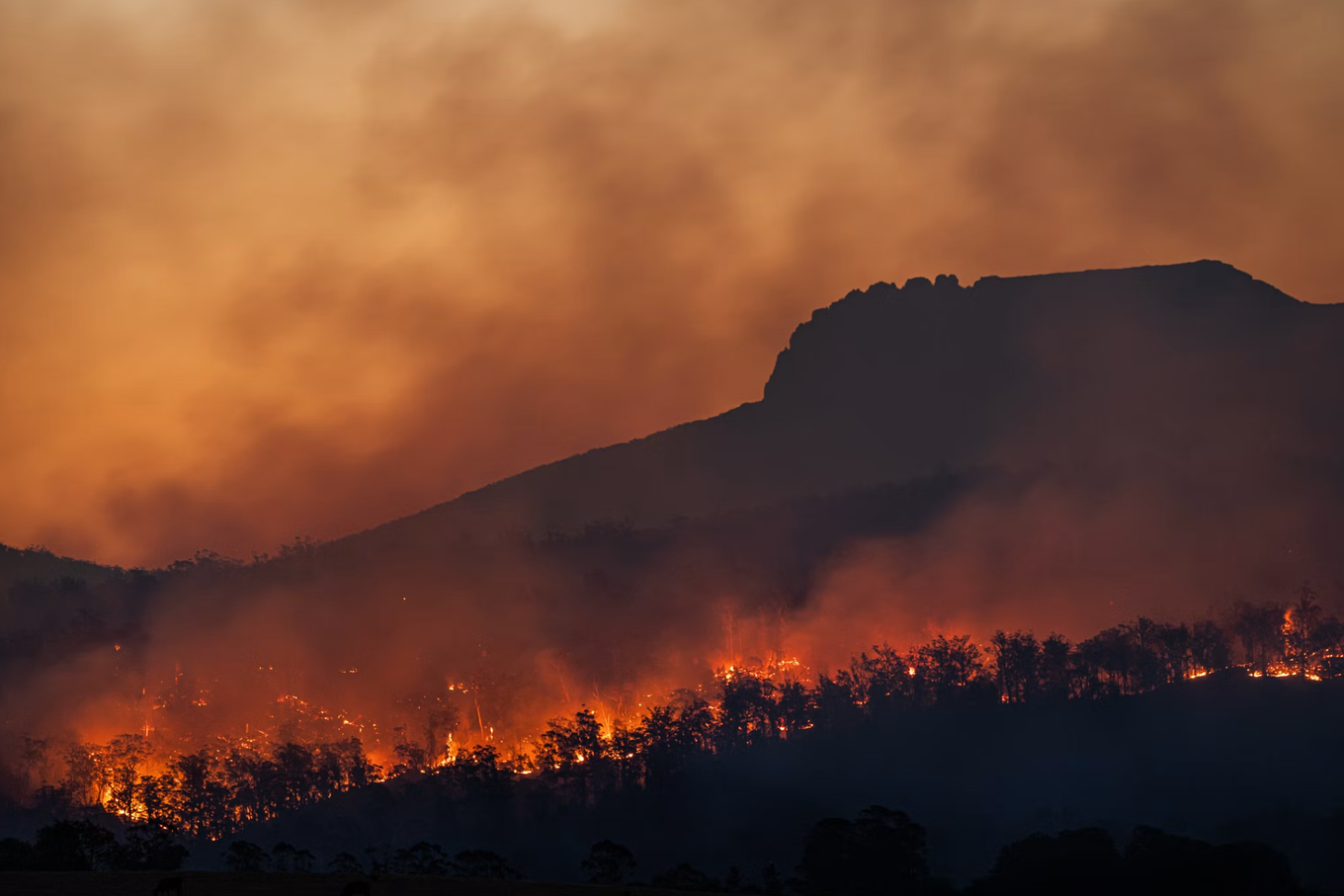
As wildfires continue to tear across Spain and France in what experts are calling the worst fire season in modern European history, the European Central Bank has issued its starkest warning yet: the destruction of natural ecosystems is no longer a long-term concern sitting at the edges of economic policy. It is, the institution says, happening now, and it threatens the stability of the financial system.
Frank Elderson, a member of the ECB’s executive board and vice-chair of its supervisory board, said the climate emergency and the breakdown of nature poses a dramatically growing risk to the global economy. Speaking as firefighters battled blazes from Madrid to Bordeaux, Elderson was unequivocal about the stakes.
“Nature-related risks can pose material economic and financial risks, including through their impacts on credit risk, growth, inflation and — over the long-term — potential financial instability.” — Frank Elderson, ECB Executive Board
A summer of fire, a winter of consequences
The scale of this summer’s destruction has been staggering. Wildfires have burned approximately 150,000 hectares in Spain, killing 13 people, while more than 116,000 hectares have been scorched across France. The fires forced more than 300,000 people to evacuate — the largest such evacuation in France’s recorded history — and prompted crisis cabinet meetings in Paris and Madrid.
In the Gironde region surrounding Bordeaux, a single fire consumed roughly 42,000 hectares and advanced to within 15 kilometres of the city, with around 14,500 businesses reported to have been affected. The cost of fighting Spain’s fires alone is estimated at between €1.72 billion and €3.28 billion, according to analysis published by Euronews Business, and that figure does not include losses in tourism, agriculture, or infrastructure recovery.
A 2023 study in the Journal of Environmental Economics and Management found that regions in southern Europe affected by large fires see their annual GDP growth reduced by between 0.11% and 0.18%, rising to between 3.3% and 4.8% in the most severe years. Tourism-related employment losses alone can amount to between 5,700 and 9,600 jobs per season across southern Europe as a whole.
“This is really a big economic challenge,” said Georg Zachmann, senior fellow at the Brussels-based think tank Bruegel, speaking to CNBC. Fires, he added, are “existential for the regions that have to pay for the evacuations, for the cost of firefighting, and eventually the infrastructure recovery.”
What the ECB is doing — and what it says is at stake
The ECB’s response has moved beyond research papers and speeches. On 15 June 2026, the bank formally introduced climate factors into its collateral framework — the system that determines how much banks can borrow from the central bank by pledging assets as security. Under this framework, assets issued by companies with greater exposure to climate-transition risks now receive a larger valuation reduction, meaning banks can borrow less against them. The immediate effect is expected to be limited, given current borrowing levels, but the signal to European lenders is pointed.
The ECB has since announced it will extend the same principle to corporate loans, which account for 29% of pledged collateral — far larger than the corporate bond market already covered. That expansion is expected to be implemented no earlier than the end of 2027. The move sends a strong signal to EU banks that loans with higher climate-transition risk are worth less as financial instruments. Analysts at environmental finance group Positive Money Europe described the loan expansion as a major step forward.
Elderson’s team at the ECB is also stepping up its monitoring of “ecosystem services” — the term used to describe natural processes and assets that underpin human economic activity, such as water supply, pollination, timber, and the regulation of temperature. The bank says it plans to publish analysis later this year examining how degradation of these services could translate into credit losses for eurozone lenders.
The modelling problem: risks that history cannot price
Central banks have always calibrated risk using historical data. Climate change creates a problem that no historical data can fully address. The ECB has acknowledged explicitly that many future effects of climate change are unprecedented, making it impossible to rely on past price behaviour to model them. Instead, it has moved to forward-looking scenario analysis — constructing uncertainty scores for individual corporate assets based on sector-level climate stress, the borrower’s specific exposure, and the remaining maturity of each loan or bond.
The ECB’s own data adds weight to the urgency. The bank has estimated that a one-in-a-hundred-year drought could put 24% of euro area economic output at risk due to surface water scarcity, and that 19% of banks’ loans to non-financial businesses are exposed to that kind of risk. Climate-related losses to infrastructure and assets in the EU were estimated at €822 billion between 1980 and 2024. Insurance coverage for wildfire and ecosystem damage remains patchy, meaning the true societal cost consistently exceeds what insurers record.
“The real impact of wildfires is often not reflected in insurance figures because large parts of the damage, particularly to forests, ecosystems, and publicly owned land, are usually uninsured,” one Bloomberg-cited risk expert noted. “The societal cost is often significantly higher than the insured cost.”
A mandate, not a preference
The ECB has been careful to frame its climate work not as a policy preference but as central to delivering on its core mandate of price stability. Droughts and poor harvests have substantial inflationary effects, its economists have noted, and extreme heat reduces labour productivity and economic growth. If physical shocks to ecosystems become frequent enough, the tools central banks use to control inflation become harder to deploy reliably.
Stefan Doerr, a professor of wildland fire science at Swansea University, told CNBC that climate change and poor landscape management are playing a major role in contributing to the current wildfires. He noted that Europe’s heavily managed forests, dominated by dense conifer plantations, are far more flammable than natural landscapes would be. Bloomberg cited climate researcher Raul Cordero Carrasco of the University of Groningen as saying that when conditions become as extreme as those seen this summer, no amount of firefighting resources can reliably stop a blaze.
For now, the ECB’s actions — embedding climate factors into monetary policy operations, expanding supervision of bank climate exposures, and publishing scenario analyses — represent the most concrete steps yet taken by a major central bank to price physical and transition climate risk into the plumbing of the financial system. Whether Europe’s governments move quickly enough on prevention and landscape management to match the central bank’s ambition is a question that the next fire season will begin to answer.
This article is free to read. It always will be — no paywall, no account, no tracking.