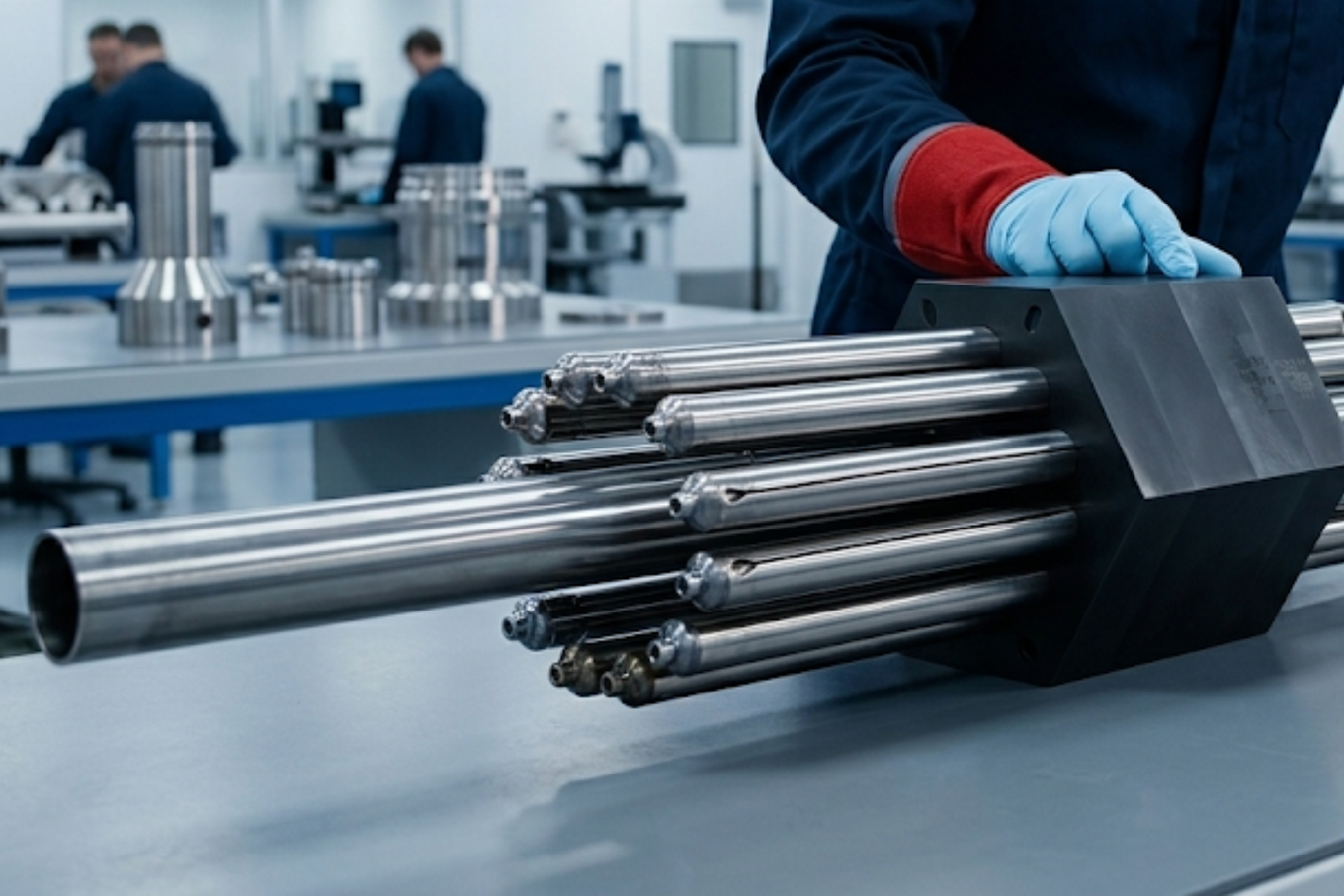
California startup Antares Nuclear has raised $470 million to build compact nuclear reactors for US military bases, the company announced on Monday. The Series C round, co-led by venture capital firms Paradigm and Caffeinated Capital with participation from Point72 Ventures, Shine Capital, and Industrious Ventures, takes Antares’ total capital raised to more than $600 million since it was founded in 2023.
The round is split into $370 million in equity and $100 million in debt. According to TechCrunch, Antares is developing a small modular reactor (SMR) capable of generating between 100 kilowatts and 1 megawatt of electricity — enough to power up to 750 homes. The company describes its reactors as factory-produced and deployable, designed to run autonomously for years without refuelling.
A presidential deadline and a proven reactor
The funding push is tied directly to a political timetable. Executive Order 14299, signed by President Donald Trump, requires the Department of Defense to have an advanced nuclear reactor operating at a domestic military installation by 30 September 2028. Antares is building to meet that deadline, with its first electricity-producing reactor scheduled to come online at Idaho National Laboratory in 2027, followed by military deployments the following year.
The company cleared a critical technical hurdle in June, when its Mark-0 demonstration reactor achieved initial criticality at Idaho National Laboratory — the point at which a nuclear chain reaction becomes self-sustaining. Antares was the first private company to reach that milestone under the US Department of Energy’s Reactor Pilot Programme, which is pushing to accelerate the deployment of advanced reactors on commercial timelines.
“Jordan and the Antares team just achieved the first private advanced reactor criticality in decades with a factory built microreactor,” said Alana Palmedo, managing partner at Paradigm. “Now they transition to a new era: the scaled deployment of microreactors that can operate reliably, safely, and economically for years on US military bases.”
Military resilience and the grid vulnerability problem
The strategic rationale behind the programme goes beyond energy costs. Many US military installations currently rely on the commercial electricity grid, which the Pentagon regards as a growing vulnerability — susceptible to extreme weather, rising demand, and potential adversary interference. Antares’ microreactors are designed to provide independent, long-duration power to bases that need to operate regardless of what happens to the surrounding civilian grid.
Antares is one of three finalists in the Pentagon’s Advanced Nuclear Power for Installations programme, which plans to test SMRs on Air Force bases in Colorado and Montana. The reactors use TRISO fuel — uranium encapsulated in carbon and ceramic shells — which has been promoted for years as a safer alternative to conventional nuclear fuel because it can withstand extreme heat without releasing radioactive material.
A crowded field, and real obstacles ahead
Antares is not alone in chasing military and commercial nuclear contracts. TechCrunch reports that X-energy raised $1 billion through an IPO in April, while Radiant Energy, Standard Nuclear, and Last Energy have each closed nine-figure rounds since December. The breadth of investment reflects a wider shift: electricity demand is surging globally, driven by the rapid expansion of AI data centres and industrial electrification, and nuclear is increasingly seen as the most reliable low-carbon option for meeting it at scale.
“We’ve secured firm contracts to build reactors,” the company said in its funding announcement. “We’re announcing $470M of equity and debt to invest one-to-one with the taxpayer in bringing this technology to commercial scale.”
Despite the momentum, significant challenges remain. The US supply chain for SMRs is still underdeveloped, and large-scale factory manufacturing has not yet been demonstrated by any startup in the sector. Analysts note that while factory production promises lower unit costs over time, no company has yet reached the point where those savings materialise. Antares’ 2028 target is ambitious, and the technology, though validated at laboratory scale, has not yet been proven in continuous commercial operation.
This article was researched and drafted with AI assistance and reviewed by Lasse Pedersen before publication. How we use AI
This article is free to read. It always will be — no paywall, no account, no tracking.