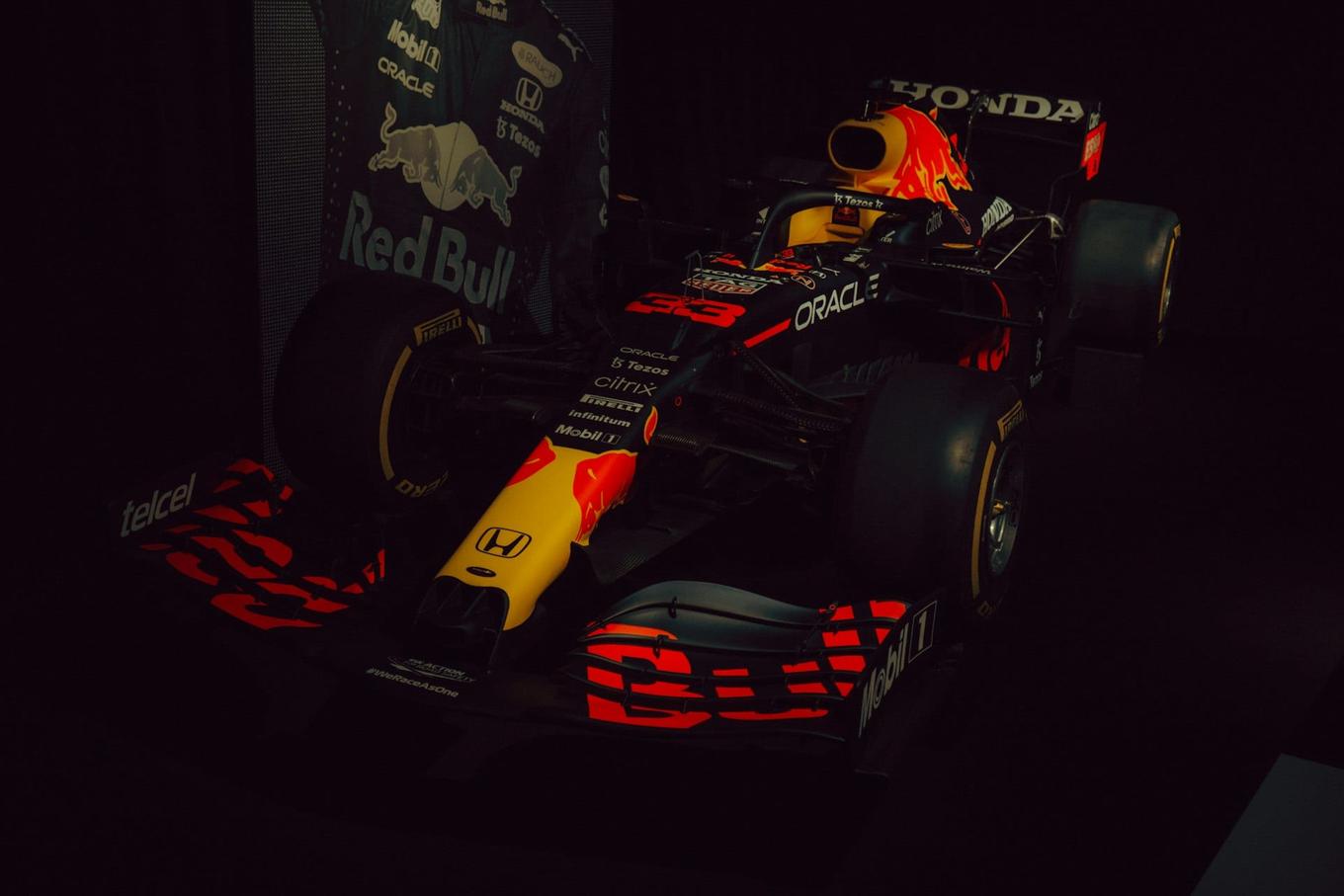
Red Bull’s first fully in-house Formula 1 engine has emerged as the car of the season’s most powerful power unit in its very first year, according to a technical analysis by The Race. The Red Bull Ford DM01 took its maiden Grand Prix victory at what was officially the Bahrain Grand Prix but had been relocated to the Sepang circuit in Malaysia, then followed it with a second consecutive win in Singapore.
Max Verstappen took pole position, fastest lap and the win in Malaysia, 16 races into the new power unit’s competitive life. It was the first pole of the 2026 season not taken by a Mercedes-powered car. In Singapore, Verstappen made his 250th Grand Prix start and won again, extending Red Bull’s run just as F1’s new engine era was supposed to be finding its feet.
A new reference engine, built without new parts
What makes the achievement notable, according to The Race, is that Red Bull has made no hardware changes to the engine at all. Under F1’s new Additional Development and Upgrade Opportunities system, known as ADUO, manufacturers judged to be behind the pace are granted extra homologation slots to update their engines mid-season. Red Bull has not used any of these tokens, because it has not needed them.
The FIA’s first ADUO assessment, carried out after the opening rounds of 2026, rated the Red Bull Ford unit as the benchmark engine. Mercedes, judged more than 2% off that benchmark, was awarded one extra homologation opportunity. Other manufacturers, including Ferrari, judged more than 4% off the pace, were granted two. A second review after the Hungarian Grand Prix reached the same conclusion: Red Bull Ford remained the reference unit, with no upgrades to claim.
Ferrari has used both of its allowances. Mercedes, despite being eligible, had not introduced new hardware by the time of reporting, and nor had Red Bull. The gap, in other words, has opened up without a single new part on either side.
There’s been a much, much deeper collaboration between the chassis and the PU side.
That quote comes from Ben Hodgkinson, Red Bull Powertrains’ technical director, who spent roughly two decades at Mercedes-AMG’s engine division in Brixworth, England, before joining Red Bull. The Race’s reporting attributes the team’s gains largely to this kind of closer integration: engine mapping and software tuned in tandem with the chassis engineers at Red Bull’s Milton Keynes base, rather than any change to the physical engine itself.
A separate upgrade to the car’s aerodynamics, introduced at the Baku race and bringing extra downforce and improved balance, is treated by the outlet as a distinct development from the engine gains, though the two together have made for a formidable package. All four cars running the Red Bull Ford power unit, two from Red Bull Racing and two from sister team Racing Bulls, finished in the top ten at the Malaysia race.
A rapid turnaround since the Porsche deal fell through
Red Bull Powertrains was only founded on 16 February 2021, after talks over a works engine partnership with Porsche collapsed. The Austrian team, previously reliant on Honda as its engine supplier, chose instead to build its own power unit in-house, with Ford signed on as a technical and commercial partner under the Red Bull Ford Powertrains badge.
For Ford, the result marks a significant return. The win in Malaysia was the first for a Ford-badged engine since 2003, and the 177th Grand Prix victory for an engine associated with the company’s long motorsport history.
As Red Bull Ford Powertrains celebrate powering this win for Oracle Red Bull Racing, we will do so by marking this as the first win for the Red Bull Ford Powertrains power unit and the 177th win for an engine associated with Ford.
That statement came from Mark Rushbrook, Ford Racing’s global director, in a release published on the company’s own motorsport site. The 2026 season also marked the start of F1’s new power-unit regulations, which roughly rebalance the split between combustion and electrical power to around 53:47, a shift that had been expected to reshuffle the competitive order across the grid.
Rivals take notice
For Ferrari and Mercedes, the extra development tokens granted under ADUO were meant to help close the gap to the front. So far, according to The Race, neither manufacturer has managed to match Red Bull Ford’s pace, hardware upgrades or not. Ferrari driver Lewis Hamilton put it plainly after the Singapore race.
To overtake the most powerful engine on the grid is not so easy.
With Red Bull Racing’s car sitting on two wins, eleven podiums, two poles and two fastest laps across 17 races at the time of reporting, the rest of the grid now faces a season in which the newest engine on the grid, built by a team with no prior experience as a full power-unit manufacturer, has become the one everyone else is measured against.
This article is free to read. It always will be — no paywall, no account, no tracking.